
CSAT Vs CES: Satisfaction Or Effort In Customer Surveys?
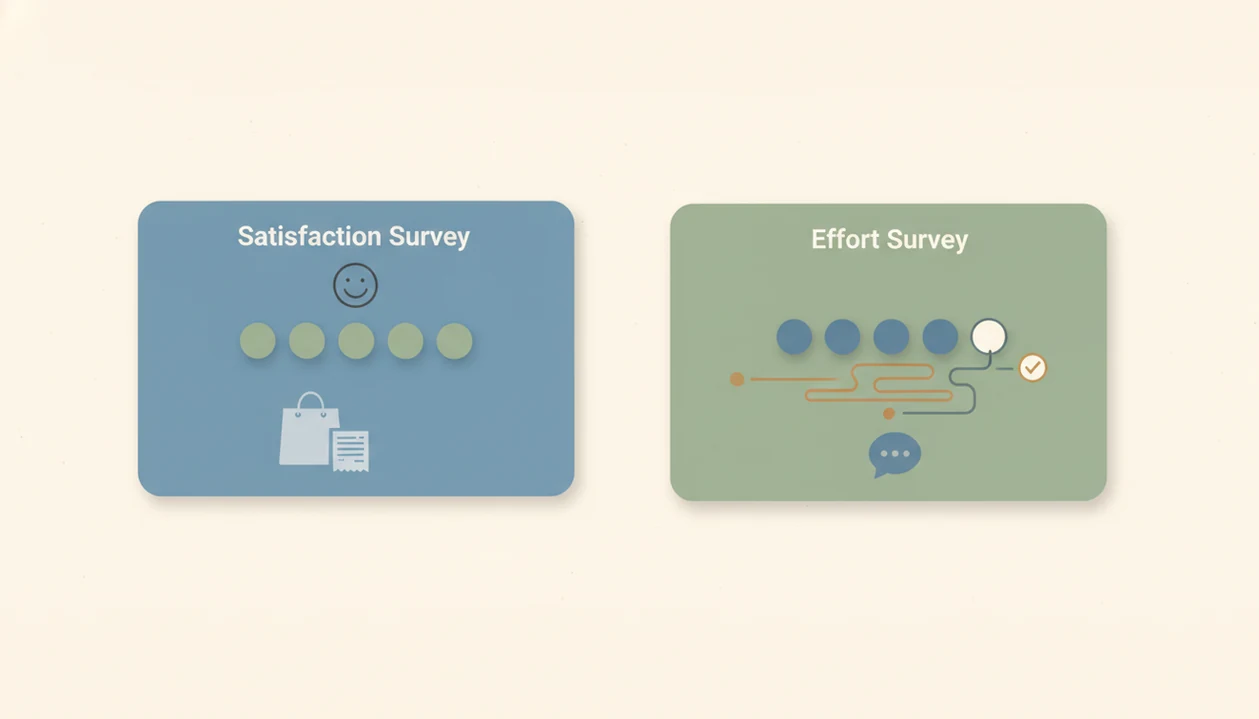
Choose CSAT when you need to know whether a customer was satisfied with a specific experience; choose CES when you need to know whether that experience was easy. CSAT vs CES comes down to happiness versus effort, especially after service, support, pickup, checkout, or post-purchase moments. Customer Feedback Surveys helps small teams ask either question at the right moment, then tie the score to a comment and a follow-up.
> Definition: CSAT measures how satisfied a customer felt after an interaction, while CES measures how much effort it took for the customer to complete a task or resolve an issue.
- Use CSAT after moments where emotion, quality, or overall satisfaction matters, such as a completed service visit, pickup experience, or purchase.
- Use CES after task-based moments where friction matters, such as support, checkout, returns, onboarding, or account changes.
- For small businesses, the best survey is usually one metric question plus one short follow-up asking why the customer gave that score.
CSAT vs CES, side by side
Side-by-side captures of the compared products. Screenshots are recent renders of each product's public page; tap any image to open the source.
CSAT vs CES at a glance for customer survey decisions
CSAT measures satisfaction; CES measures effort. Both are transactional customer survey metrics, so they work best when sent soon after the interaction they are meant to measure.
| Decision point | CSAT survey | CES survey |
|---|---|---|
| Core question | “Were you satisfied?” | “Was it easy?” |
| Best after | Service visit, purchase, pickup, delivery, food order | Support ticket, return, checkout, booking, onboarding |
| What it reveals | Emotion, quality, friendliness, product fit | Friction, delays, confusing steps, repeated contacts |
| Small-business example | A salon asks after checkout whether the appointment met expectations | A shop asks after a return whether the process was easy |
| Main weakness | A happy outcome can hide a painful process | An easy process can still feel bland or disappointing |
Neither metric explains the reason by itself. The score tells you where to look; the follow-up comment tells you what to fix.
Customer Feedback Surveys fits teams that want one short post-purchase survey instead of a long research form, because it pairs CSAT or CES with a short open-text prompt and a review follow-up workflow.
How CSAT and CES surveys work after customer interactions
CSAT and CES surveys work by attaching a short rating question to a specific customer interaction, then reviewing the score and comment as a trend over time. The usual flow is simple: interaction, survey trigger, rating response, optional comment, team review, next action.
Memory fades quickly. A receipt link printed below the total, a delivery confirmation email after lunch, or a text after a service appointment catches the customer while the experience is still available in plain language.
CSAT captures emotional evaluation. CES captures process friction. In other words, CSAT asks whether the customer liked what happened; CES asks how much work it took to get there.
For a satisfaction benchmark context, the American Customer Satisfaction Index explains customer satisfaction as a measured relationship between expectations, perceived quality, and perceived value: https://www.theacsi.org/about-acsi/the-science-of-customer-satisfaction/.
Keep the wording, scale, and timing steady. If Monday’s survey uses a 1-5 satisfaction scale and Friday’s uses smiley faces after a different delay, the trend line gets muddy fast.
Good customer feedback survey apps deliver timely post-interaction signals and usable follow-up notes, not a giant dashboard nobody checks before opening the register.
Where CSAT wins for satisfaction survey moments
CSAT wins when the business wants to know whether the customer liked the experience. It is the better choice when quality, friendliness, speed, product fit, or the overall feeling matters more than the number of steps.
Best CSAT touchpoints for small businesses
- Completed service appointment: Ask after a haircut, repair, consultation, or spa visit when the result is fresh.
- Store visit or purchase: Use CSAT when a regular shopper mentions the parking lot, the staff, or the product selection.
- Food order or pickup: Ask whether the meal, packaging, wait time, and handoff felt right.
- Delivery experience: Use CSAT after a package arrives, especially if product condition or timing affects the mood.
- Support outcome: Ask CSAT after the issue is resolved, not while the customer is still waiting.
For local teams, CSAT is often more useful than CES after a service or purchase because the business needs to know whether the customer felt well served.
Customer Feedback Surveys works well for CSAT touchpoints because it can send a short satisfaction question after checkout, pickup, delivery, or a service visit. The practical mechanism is a post-purchase survey with one rating and one “What made you choose that score?” comment box.
High CSAT can still hide friction. A customer may love the final haircut but resent waiting 25 minutes past the appointment time.
Where CES wins for customer effort score vs satisfaction
Use CES when the customer had to complete a task, fix a problem, or move through a process. Customer effort score vs satisfaction is really a question of whether friction matters more than emotion in that moment.
Best CES touchpoints for small businesses
- Support tickets: Ask how easy it was to get help, especially when the support inbox is full of order numbers.
- Returns and exchanges: Measure effort when the returns pile behind the counter keeps growing.
- Checkout and booking: Use CES when customers abandon carts, forms, reservations, or appointment slots.
- Onboarding and account updates: Ask after setup, password changes, plan changes, or profile edits.
- Service recovery: Measure ease after a refund, remake, replacement, or apology follow-up.
Customer service research is one reason CES gets attention after support and recovery moments. Harvard Business Review’s summary of CEB research reported that 94% of customers with low-effort service interactions intended to repurchase, compared with much weaker loyalty after high-effort interactions: https://hbr.org/2010/07/stop-trying-to-delight-your-customers.
If repeated contacts are the problem, Customer Feedback Surveys fits because low-effort scores can be reviewed beside customer comments and assigned follow-ups. A kitchen ticket curling on the rail is a service moment; a customer having to call twice about it is an effort problem.
Who should choose CSAT vs CES?
Choose CSAT when the main question is whether the customer felt satisfied with the outcome. Choose CES when the main question is whether the customer had to work too hard to get that outcome.
A salon, repair shop, clinic, restaurant, or local retailer should lean toward CSAT when feeling, quality, service tone, or the final result matters most. CES is the better fit when the pain is friction: repeated calls, confusing forms, abandoned checkout, unclear return steps, or customers doing extra work your process should have handled.
- Choose CSAT when you need to judge satisfaction with a visit, purchase, completed service, food order, pickup, delivery, or resolved issue.
- Choose CES when the pattern is delay, rework, duplicate contact, task failure, or customers asking, “Why is this so hard?”
- Use both only when satisfaction and effort are part of the same moment, such as a replacement that fixed the problem but took too many steps.
- Avoid CES for mostly emotional brand, product, hospitality, or ambience feedback, where “easy” is not the point.
- Avoid CSAT when the real issue is process complexity, customer workload, or preventable friction.
How to use CSAT vs CES in a small-business survey plan
Use CSAT vs CES by choosing the business question first, then matching the metric to one customer moment. Do not start with the dashboard; start with the decision you need to make next Friday.
- Set the goal before choosing the metric: satisfaction, effort, recovery, repeat purchase risk, or review follow-up.
- Pick CSAT for satisfaction when you need to know whether the customer liked the visit, order, service, or purchase.
- Pick CES for effort when you need to know whether checkout, support, returns, booking, or onboarding felt easy.
- Send the survey immediately after the relevant interaction by email, SMS, QR code, or receipt link.
- Add one follow-up question for low or high scores, such as “What is the main reason for your score?”
- Review results by touchpoint and assign the fix by naming one owner, one driver, and one date for the next check-in.
The right fit for owner-led follow-up is Customer Feedback Surveys because it turns a low CSAT or CES response into a private recovery task before it becomes a one-star public review.
If you also track loyalty, compare this plan with NPS surveys, which answer a broader recommendation question.
CES survey vs CSAT survey question wording and scoring
CES survey vs CSAT survey wording should stay short, plain, and consistent. Changing the question every week makes the spreadsheet look active but breaks the trend.
Use the same scale, trigger, and channel for several weeks before comparing trends. If the score changes after the wording changes, you may be measuring the new question rather than the customer experience.
CSAT survey question example
“How satisfied were you with your experience?”
CES survey question example
“How easy was it to complete your task?”
- Fact 1: CSAT questions usually ask about satisfaction with an experience, visit, purchase, service, or support outcome.
- Fact 2: CES questions usually ask how easy it was to complete a task or resolve an issue.
- Fact 3: Common survey scales include 1-5, 1-7, smiley faces, stars, or satisfied-to-unsatisfied labels.
- Fact 4: Frequent wording or scale changes make score comparisons unreliable across weeks, locations, or channels.
- Fact 5: For most small businesses, one metric question plus one open-text follow-up gets cleaner responses than a long form.
Customer Feedback Surveys supports short CSAT and CES formats because small teams usually need an answer they can read between customers, not a 22-question research instrument.
Teams comparing satisfaction metrics more broadly can use the NPS vs CSAT guide to decide when loyalty, satisfaction, or both should be measured.
CSAT and CES together for post-purchase feedback
CSAT and CES can be used together when satisfaction and friction both matter, but they should not be crammed into every survey. Tie each question to a clear moment, or rotate them by touchpoint.
A customer may be happy with a replacement lid but annoyed that they had to send three photos and wait four days. That is high CSAT with poor CES. Another customer may check out in 40 seconds but feel the product advice was cold or rushed. That is decent CES with weak CSAT.
Customer Feedback Surveys can support both patterns as a post-purchase survey app for small businesses because each survey can be attached to a purchase, pickup, delivery, or service recovery moment. A customer photo of a cracked lid belongs with the comment, not buried in a monthly meeting.
For a shop comparing QR codes, SMS, and receipt links, the best QR code feedback survey app guide covers in-store collection in more detail.
After a mixed experience, when the outcome is good but the process was clumsy, Customer Feedback Surveys handles the split by keeping CSAT, CES, and the customer’s explanation in the same feedback workflow.
Evidence and benchmarks for CSAT vs CES
The evidence base is simple: CSAT is strongest as a satisfaction snapshot, while CES is strongest as a friction signal after task-based experiences. ACSI is often used for satisfaction benchmarking, and CEB/HBR research is often cited for the link between low-effort service and loyalty behavior.
Benchmarks still need caution. A restaurant pickup survey sent by SMS five minutes after handoff will not behave like a clinic email sent two days later, even if both use a 1-5 scale. Industry norms, channel mix, survey timing, customer mood, and the type of interaction all move the score.
- Track your own baseline for several weeks before comparing against outside averages.
- Segment results by touchpoint, such as checkout, support, delivery, pickup, or service recovery.
- Compare trends before chasing a published benchmark that may come from a different industry or survey method.
- Read comments beside the score so a rising CSAT or CES number does not hide the actual driver.
- Treat both metrics as directional signals, not complete loyalty measures; repeat purchase, referrals, reviews, and retention still need separate attention.
Limitations
CSAT and CES are useful snapshot metrics, but they can be overread. Treat each score as a signal from one moment, not as a full description of the customer relationship.
- CSAT and CES can miss broader loyalty, habit, price sensitivity, and repeat-purchase behavior.
- A high CSAT score does not guarantee referrals, reviews, or another visit next month.
- A good CES score does not prove the customer loved the experience.
- Scores are often misleading without an open-ended follow-up question.
- Survey timing, wording, scale choice, and channel can change the result.
- Small sample sizes make location, staff, or touchpoint comparisons noisy.
- Too many surveys can create fatigue and lower response quality.
- Typeform, SurveyMonkey, Google Forms, Jotform, and Qualtrics may be better when a team needs custom research forms, complex branching, or enterprise reporting.
However, small-business practicalities matter. The owner checking yesterday’s survey comments before opening the register needs fewer charts and clearer next steps.
Customer Feedback Surveys is a practical fit when the goal is timely feedback and private follow-up, because it focuses on post-purchase surveys, NPS and CSAT, review follow-ups, and low-score recovery workflows. If loyalty scoring is the next layer, the best NPS survey app comparison explains that choice separately.
FAQ
What is CSAT?
CSAT is customer satisfaction score, a metric that measures how satisfied a customer felt after a specific interaction. It is commonly used after purchases, visits, service appointments, pickups, and support outcomes.
What is CES?
CES is customer effort score, a metric that measures how easy it was for a customer to complete a task or solve a problem. It is often used after support, checkout, returns, onboarding, booking, or account changes.
Is CSAT better than CES?
CSAT is not universally better than CES because the two metrics answer different questions. Use CSAT for satisfaction and CES for effort.
When should I use CSAT?
Use CSAT after moments where the customer’s feeling about the experience matters. Common examples include a purchase, store visit, completed service, food order, pickup, delivery, or resolved support issue.
When should I use CES?
Use CES after moments where the customer had to complete a process or remove friction. Common examples include support tickets, checkout, returns, booking, onboarding, account updates, and service recovery.
Can CSAT and CES overlap?
Yes, CSAT and CES can overlap when a business needs to measure both satisfaction and friction. Keep the survey short by tying each metric to a clear customer moment.
What is a good CES question?
A good CES question is: “How easy was it to complete your task?” It should be followed by one optional comment question asking why the customer gave that score.
What is a good CSAT question?
A good CSAT question is: “How satisfied were you with your experience?” Customer Feedback Surveys can pair that rating with one open-text follow-up for small-business review and recovery workflows.