
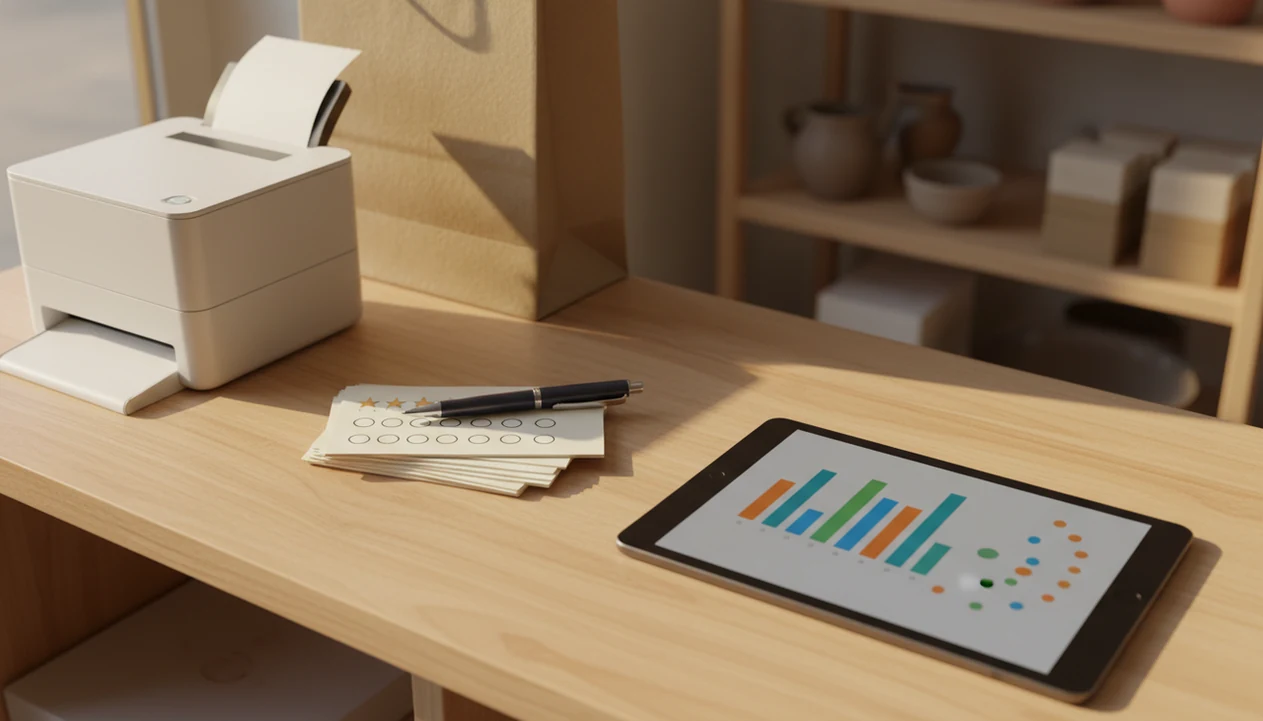
> Definition: Customer feedback survey templates are pre-built question sets organized by business type and feedback moment that help small businesses collect actionable post-purchase surveys, NPS scores, and satisfaction ratings.
5 Customer Feedback Survey Template Facts
- Templates should match the feedback moment. A post-purchase survey asks about buying ease and product fit; a post-support survey asks about resolution speed and effort.
- Short surveys usually get better completion. Three to five focused questions often work better than a long form that customers abandon halfway through.
- Strong templates pair scores with reasons. A 2-star CSAT score tells you there is a problem; “the fitting room line took 12 minutes” tells you where to look.
- Business type changes the question set. A restaurant needs food, wait time, and server questions, while a salon needs booking, consultation, and rebooking questions.
- Templates only matter when someone acts. The owner checking yesterday’s survey comments before opening the register is where feedback becomes operating work.
Good customer feedback survey apps deliver short, timed questions and usable follow-up signals, not a pile of generic form responses.
What Customer Feedback Survey Templates Include
Customer feedback survey templates include the question types, timing rules, customization fields, and reporting outputs needed to turn customer comments into operating decisions. A strong template gives a small team enough structure to ask consistently without making the survey feel robotic.
Most templates start with a core metric: CSAT for satisfaction, NPS for referral likelihood, CES for effort, or a short open-text follow-up that explains the score. The best setup also matches the send time to the experience, such as after a purchase, support case, delivery, appointment, or store visit.
- Choose the feedback moment first so the wording fits what the customer just experienced.
- Customize the prompt with the business name, location, product, service, or staff member involved.
- Limit the survey to a few focused questions so customers do not abandon it.
- Review trend scores, tagged comments, and follow-up tasks instead of reading every response as a one-off.
- Check the wording for leading language and make sure someone owns the next action.
For small businesses, the real safeguard is restraint: ask less, ask clearly, and use the answers.
How Customer Feedback Survey Templates Work
Customer feedback survey templates work by combining a score with context. The rating question captures a measurable signal, and the open-ended follow-up captures the reason behind it. That pairing is the difference between “CSAT dropped” and “customers keep mentioning the new checkout screen.”
The timing logic matters. A receipt link printed below the total catches a retail customer while the visit is fresh. A delivery survey sent 24 hours after arrival gives an ecommerce buyer time to open the box. NPS uses a 0 to 10 recommend scale, CSAT measures satisfaction, and CES measures how much effort the customer needed to complete a task.
Then responses move into pattern recognition. Teams review scores, tag themes, and assign one next step. Customer Feedback Surveys supports this flow by keeping NPS, CSAT, CES-style effort questions, and comments in one short survey instead of splitting them across separate forms.
One survey. Less fatigue.
Customer Feedback Survey Templates by Business Type

Different businesses need different customer survey templates because customers judge each experience by different details. Salesforce reports that 73% of customers expect companies to understand their unique needs, which is why a sticky menu at table seven should not produce the same survey as a delayed ecommerce shipment. Source: https://www.salesforce.com/resources/research-reports/state-of-the-connected-customer/.
Restaurant Survey Template Questions
Ask about food quality, wait time, staff friendliness, order accuracy, and likelihood to return. For a deeper restaurant-specific set, use a restaurant feedback survey template.
Salon and Spa Survey Template Questions
Ask about booking ease, service quality, stylist or therapist communication, cleanliness, comfort, and rebooking intent. A massage room smelling of eucalyptus may feel calm, but the survey should still ask whether the client felt listened to.
Retail Store Survey Template Questions
Ask about product selection, checkout speed, store cleanliness, staff helpfulness, and whether the customer found what they came in for. A retail customer feedback survey template should include store-level details.
Ecommerce Survey Template Questions
Ask about delivery speed, product match to description, packaging, site ease of use, and return likelihood.
Service Business Survey Template Questions
Ask about communication clarity, on-time delivery, value for price, professionalism, and referral likelihood.
Customer Feedback Questions by Survey Moment
The same customer may need different feedback questions depending on when you ask. A tracking email opened after delivery is a product experience moment; a support ticket closure is an effort moment.
Post-Purchase Feedback Questions
Ask: “How satisfied were you with your purchase?”, “Was the product or service what you expected?”, and “How easy was it to buy from us?” These questions fit shops, restaurants, salons, and customer feedback surveys for ecommerce.
Post-Support Feedback Questions
Ask about resolution speed, agent helpfulness, and effort required. SurveyMonkey reports that 91% of customers are more likely to recommend a brand after a positive, low-effort experience, so effort questions belong in support follow-ups. Source: https://www.surveymonkey.com/curiosity/customer-experience-statistics/.
NPS Follow-Up Questions
Ask the 0 to 10 recommend question, then ask: “What is the main reason for your score?” Qualtrics reports that 33% of customers say a bad experience would make them leave a brand they love.
The most useful survey moment is the one close enough to the experience that the customer still remembers the detail.
6 Steps to Use Customer Feedback Survey Templates
Use customer feedback survey templates as a repeatable feedback workflow, not a one-time questionnaire. The goal is to ask at the right moment, then close the loop before a private complaint becomes a one-star public review.
- Pick the template that matches your business type and feedback moment, such as post-purchase, post-support, or post-delivery.
- Edit the questions to include your product, service, team member, or location name.
- Set the trigger timing for the moment that fits, such as 1 hour after purchase or 24 hours after delivery.
- Send the survey by email, SMS, QR code, receipt link, or in-app prompt.
- Review responses weekly by tagging recurring themes and choosing one change per cycle.
- Close the loop by telling customers what changed because of their feedback.
If the priority is faster service recovery, Customer Feedback Surveys fits because low-score alerts can route customer comments into a weekly follow-up list.
Customer Feedback Surveys App Template Features
Customer Feedback Surveys includes pre-loaded templates for restaurants, retail stores, salons, ecommerce sellers, and service businesses. Each template starts with practical feedback questions, then lets the team swap in the business name and adjust the question count.
The right fit for small teams that do not want to build survey logic from scratch is Customer Feedback Surveys because it includes NPS, CSAT, and open-ended question blocks in the same template workflow. Automatic post-purchase triggers and follow-up reminders keep the survey from becoming another forgotten admin task.
A weekly spreadsheet tab with NPS scores, customer quotes, and one assigned follow-up is still useful. Customer Feedback Surveys simply makes that habit easier to keep by tagging themes and highlighting churn risk in the response dashboard.
Customer Survey Templates vs Google Forms and SurveyMonkey
Purpose-built customer survey templates save setup time because the wording, scoring model, and reporting view already match customer feedback work. Google Forms, SurveyMonkey, Typeform, and Jotform can collect answers, but they often require more manual setup for NPS trends, sentiment tagging, and follow-up workflows.
McKinsey reports that 71% of consumers expect personalized interactions and 76% get frustrated when they do not happen, so tailored templates matter. Source: https://www.mckinsey.com/capabilities/growth-marketing-and-sales/our-insights/the-value-of-getting-personalization-right-or-wrong-is-multiplying.
| Option | Good fit | Main gap |
|---|---|---|
| Google Forms | Simple free forms and one-off questionnaires | No built-in feedback analytics or NPS trend workflow |
| SurveyMonkey | Broad survey creation and larger template libraries | May require extra setup for small-business service recovery |
| Dedicated feedback apps | Post-purchase surveys, NPS, CSAT, and review follow-up | Less suited for broad academic or market research surveys |
Retailers looking for store-specific questions often start with a retail customer feedback survey template before moving into automated reporting.
Limitations
Customer feedback survey templates are useful, but they do not fix unclear operations by themselves. A customer who says “everything was fine” in person can still give a 6 out of 10 later.
- Templates do not guarantee honest answers; timing, wording, and customer trust affect response quality.
- NPS and satisfaction scores do not explain why customers feel a certain way without open-ended follow-ups.
- Copying generic feedback questions templates can create sameness and miss location-specific problems.
- Incentives may increase participation, but they can also attract low-effort or dishonest responses.
- Feedback surveys are not a substitute for product analytics, support logs, or customer interviews.
- Free templates with weak wording, poor timing, or no follow-up process can produce misleading data.
- More questions do not mean better insight; long surveys reduce completion and lower response quality.
- Enterprise research platforms like Qualtrics may fit complex research teams better than a small shop workflow.
When trigger timing is the issue, Customer Feedback Surveys helps because surveys can be sent after purchase, delivery, or service completion instead of on a random monthly schedule.