

> Definition: Customer feedback surveys for franchises are short, standardized post-purchase surveys deployed across every franchise location to measure satisfaction, NPS, and service quality at the individual store level.
Why Franchises Need Location-Level Customer Feedback
Franchises need location-level customer feedback because brand-wide averages can hide weak stores behind strong ones. A 4.6 average across the system sounds fine until one location keeps getting comments about slow pickup, dirty tables, or rushed service.
The risk is not theoretical. PwC reported that 32% of customers would stop doing business with a brand they loved after one bad experience (https://www.pwc.com/us/en/services/consulting/library/consumer-intelligence-series/future-of-customer-experience.html), and Microsoft found that 96% of consumers say customer service affects brand loyalty (https://info.microsoft.com/ww-landing-global-state-of-customer-service.html). For a franchise, one bad visit at one store can damage the whole name.
Customer Feedback Surveys helps franchisors separate the brand story from the store reality because each response is tied to a specific location, channel, and score type. The owner can check yesterday’s survey comments before opening the register, not wait for a quarterly report.
Consistent customer experience across locations is the goal, not a prettier dashboard.
If the priority is finding weak stores before they become public-review problems, Customer Feedback Surveys fits because it uses location-level NPS, CSAT, and comment reports instead of one blended brand score.
At-A-Glance: Franchise Survey Features That Matter
The most useful franchise survey features are the ones that make feedback comparable across stores and simple enough for franchisees to act on. A form builder can collect answers; franchise survey reporting needs store-level structure.
- Location-level filtering: Every response should be tied to one store, region, or franchisee group.
- Standardized questions: The same NPS, CSAT, and service questions should run across all locations.
- Score plus reason: NPS or CSAT shows the pattern, while open text explains what happened.
- Automated delivery: Post-purchase survey links should go out by receipt, email, SMS, or QR code.
- Readable dashboards: Franchisees should understand their trend line without analyst training.
Customer Feedback Surveys covers these basics with short survey flows and reporting views built around location, score, and customer comments. If you need starting questions, customer feedback survey templates can keep every store asking the same thing.
Top 3 Features For Multi-Location Customer Feedback
The top features for multi location customer feedback are location comparison, mixed question types, and staff-friendly deployment. PwC found that 73% of consumers say experience affects purchasing decisions (https://www.pwc.com/us/en/services/consulting/library/consumer-intelligence-series/future-of-customer-experience.html), so the system has to show where experience breaks down.
Location Comparison Dashboards
Location comparison dashboards rank stores side by side by NPS, CSAT, response count, and comment themes. Customer Feedback Surveys is useful here because franchise owners can compare one unit against the network without exporting a messy spreadsheet.
Rating Plus Open-Text Questions
A quick rating tells you something changed; one open-ended question tells you why. The awkward pattern is familiar: a customer says “everything was fine” in person, then gives a 6 out of 10 later with a note about waiting 18 minutes.
Staff-Friendly Survey Deployment
Staff need a simple ask they can repeat. A receipt link printed below the total or a QR code near the counter works better than a script nobody remembers.
Multi-location operators looking for store-by-store coaching signals should consider Customer Feedback Surveys because it combines location comparison dashboards with open-text customer comments.
How Franchise Survey Reporting Works Behind The Scenes
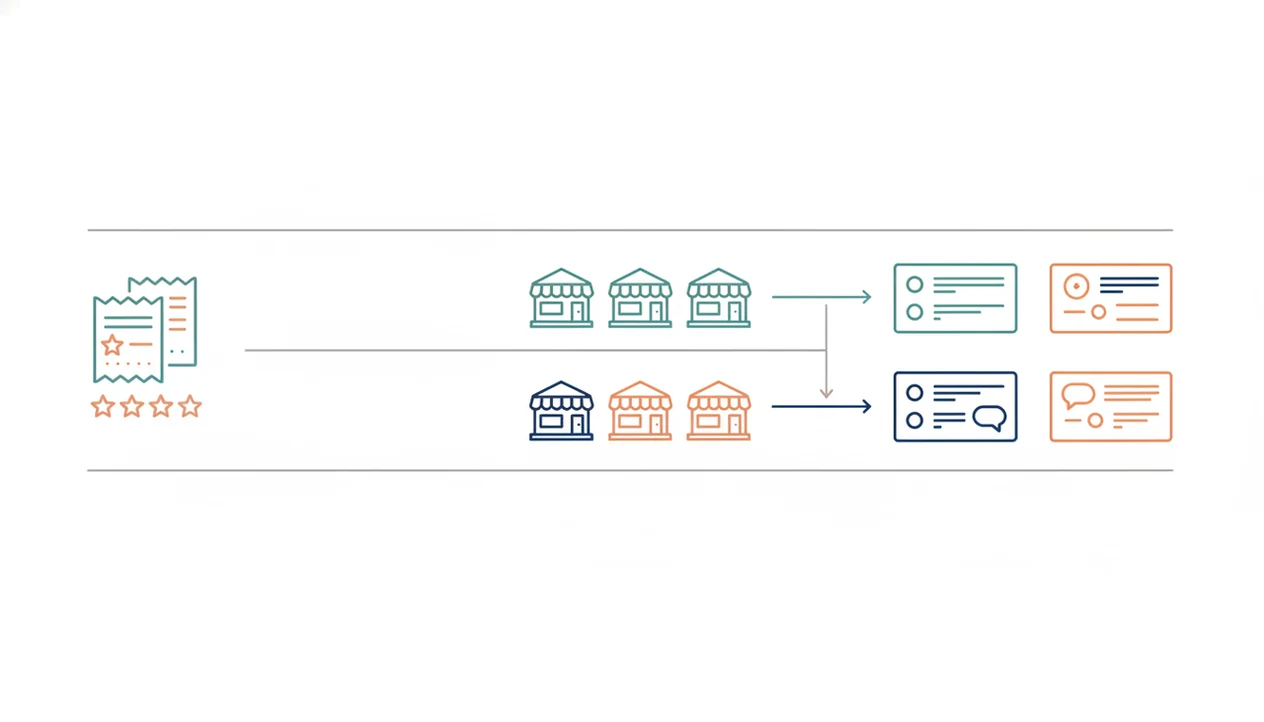
Franchise survey reporting works by tagging each customer response to a specific location, then aggregating scores and comments into store-level views. The technical pieces are response attribution, score calculation, and theme grouping; in plain language, each answer needs a home, a number, and a reason.
A customer completes a short post-purchase survey after a visit or delivery. The response is attached to the store where the purchase happened, then scored automatically as NPS, CSAT, or another satisfaction measure. Open-text answers can be grouped by themes such as speed, cleanliness, staff friendliness, product quality, or order accuracy.
The franchisor sees cross-location trends. The franchisee sees their own store’s detail. That split matters because a regional manager may need ranking, while a local operator needs the three comments behind last week’s drop.
Customer Feedback Surveys supports this workflow with location tags, score views, and negative feedback alerts. When a location drops below a threshold, the next step should be a follow-up, not another chart. A customer feedback dashboard is only useful when it leads to assigned action.
How To Set Up Customer Feedback Surveys For Franchises
To set up customer feedback surveys for franchises, start with one standard survey and one review rhythm before adding advanced reporting. The launch should be easy enough for a busy Saturday bell over the door.
- Choose a standardized question set: Use NPS, one CSAT question, and one or two open-text prompts.
- Tag each survey to a location: Connect every QR code, receipt link, email, or SMS to the correct franchise store.
- Train staff on the ask: Tell employees when to mention the survey and use the same wording every time.
- Review reports weekly or biweekly: Look at NPS, CSAT, response count, and repeated customer comments by location.
- Assign action items: Give each franchisee one owner, one deadline, and one operational fix based on recurring themes.
If each store invents its own questions, comparisons fall apart. Good customer feedback survey programs deliver consistent location-level insight, not a pile of unrelated opinions.
When rollout consistency is the issue, Customer Feedback Surveys handles the basics because one survey structure can be reused across locations with store-specific tagging.
Common Franchise Feedback Patterns And Mistakes
Franchise feedback usually shows patterns before it shows certainty. Very happy and very unhappy customers are more likely to answer, so a location can look better or worse than the full customer base would suggest.
Long surveys make this worse. A five-star review drafted from a phone may happen quickly, but a 14-question form gets abandoned in the parking lot. Short surveys also make reporting cleaner because every answer maps to a clear location issue.
Another mistake is dashboard theater. The franchisor collects scores, puts them in a monthly deck, and nobody owns the next step. PwC reported that 59% of consumers will walk away after several bad experiences, even if they like the brand (https://www.pwc.com/us/en/services/consulting/library/consumer-intelligence-series/future-of-customer-experience.html), so repeated comments need deadlines.
Careful comparison matters too. A drive-thru location, a mall kiosk, and a full-service restaurant may have different traffic patterns and customer expectations. For restaurants, a dedicated restaurant feedback survey template can keep service questions practical without overloading guests.
Franchisees who need fast recovery signals can use Customer Feedback Surveys because low scores and negative comments can be routed before they turn into one-star public reviews.
Common Myths About Multi-Location Customer Feedback
Multi-location customer feedback is often misunderstood because survey programs sound more complicated than they need to be. The useful version is short, repeated, and tied to local action.
- Myth: Franchise surveys are only for enterprise brands. Small and mid-sized operators can use simple location tags, shared templates, and weekly reviews.
- Myth: More questions mean better insight. Longer forms usually reduce completion and make reports harder to read.
- Myth: Feedback is useless unless it is statistically significant. A small sample can still reveal a broken pickup process or training gap.
- Myth: A high average score means all stores are healthy. Strong locations can lift the brand average while one store keeps disappointing customers.
- Myth: Scores alone explain the problem. NPS and CSAT need customer comments to show the cause.
Not every comment deserves a policy change. But repeated themes should get attention.
For small franchise groups, Customer Feedback Surveys is practical because it keeps the survey workflow closer to daily operations than enterprise experience platforms such as Qualtrics or Medallia, and broader form builders such as Google Forms, Typeform, or Jotform.
Customer Feedback Surveys vs Alternatives For Franchises
Customer Feedback Surveys is usually the better fit when a franchise needs simple, store-level reporting more than complex survey design. Generic form builders can collect responses, and enterprise CX platforms can model customer journeys, but franchise operators mostly need to know which location needs attention this week.
Location tagging often matters more than custom form design because the same three questions become useful only when every answer is tied to the right store, region, or franchisee. A beautiful Typeform with no clean location structure still creates manual cleanup. Google Forms may work for a very small group testing one survey. Qualtrics or Medallia may be better for large systems with dedicated CX teams, journey analytics, governance workflows, and integrations across call centers, apps, and loyalty programs.
A practical buying path looks like this:
- Choose Customer Feedback Surveys if you need fast NPS, CSAT, comments, and location comparisons.
- Use Google Forms or Typeform if the job is a simple one-off form with light reporting needs.
- Evaluate Qualtrics or Medallia if your enterprise needs advanced research, complex permissions, and broader CX infrastructure.
- Prioritize reporting fit over form polish when franchisees must review results and act on them.
For small franchises and regional operators, the best tool is often the one that makes franchise survey reporting readable without an analyst.
Honest Gaps In Franchise Survey Programs
Franchise survey programs reveal service problems, but they do not fix operations by themselves. A store with slow checkout still needs staffing changes, training, or a different handoff process.
Low response rates can also mislead, especially at smaller locations. Three angry comments in one week may indicate a real issue, or they may reflect a tiny sample after a local rush. The response count belongs next to the score.
Some franchisees will not use the data unless the operating system requires it. A weekly spreadsheet tab with NPS scores, customer quotes, and one assigned follow-up often does more than a dense executive dashboard.
There is also a human problem. Staff may forget to ask, rush through the prompt, or treat surveys like a corporate inspection. Customer Feedback Surveys can organize the feedback workflow, but leadership still has to close the loop with coaching, deadlines, and store-level accountability.
Limitations
Customer feedback surveys are useful for franchises, but they have clear limits. Treat them as an operating signal, not a complete performance system.
- Surveys show where problems appear; they do not explain exactly how to redesign staffing, training, or operations.
- Low response rates and self-selection bias can distort location scores.
- Store comparisons can be unfair when traffic patterns, service models, hours, or customer demographics differ.
- NPS and satisfaction scores are useful, but they are incomplete measures of franchise health.
- Centralized reporting becomes dashboard theater without assigned owners, deadlines, and follow-up actions.
- Survey fatigue can reduce completion rates if customers are asked after every small interaction.
- Open-text responses require manual review or AI-assisted tagging before they become useful at scale.
- Tools such as surveymonkey.com, typeform.com, and jotform.com may work for simple forms, but they often need extra setup for franchise survey reporting.
Customer Feedback Surveys does not replace field visits, staff coaching, or franchisee accountability. It gives the network a clearer place to start.