
> An NPS survey is a customer feedback form built around one core question, 'How likely are you to recommend us?', scored 0–10, that categorizes respondents as promoters (9–10), passives (7–8), or detractors (0–6) and produces a single loyalty metric from -100 to +100.
- NPS surveys distill customer loyalty into one score using a 0–10 recommend question.
- Small businesses trigger branded NPS feedback surveys post-purchase to catch detractors early and route promoters to reviews.
- Pairing the numeric score with an open-ended follow-up turns raw data into actions like staff coaching, service fixes, and referral campaigns.
At a Glance: NPS Surveys in Five Facts
NPS surveys give small businesses one loyalty number, but the useful work comes from sorting customers and reading the comments behind the score.
- One question drives the survey: customers answer, “How likely are you to recommend us?” on a 0–10 scale.
- Three customer groups matter: 9–10 scores are promoters, 7–8 scores are passives, and 0–6 scores are detractors.
- The formula is simple: Net Promoter Score equals the percentage of promoters minus the percentage of detractors, using the standard NPS classification described by Bain & Company: https://www.netpromoter.com/know/
- The score range is fixed: NPS runs from -100 to +100, so trend lines are easy to compare week by week.
- The follow-up question makes it actionable: “What is the main reason for your score?” explains the number.
A weekly spreadsheet tab with NPS scores, customer quotes, and one assigned follow-up often tells the owner more than a thick report ever would.
How Net Promoter Score Surveys Work
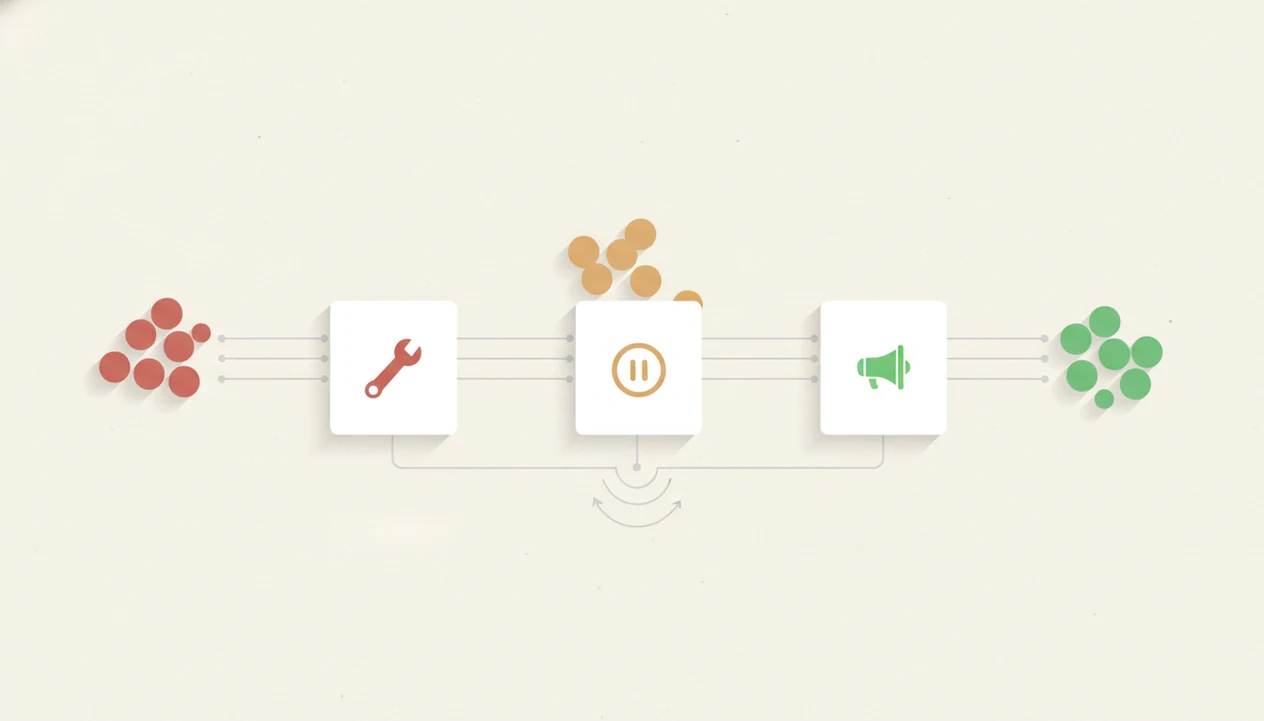
Net Promoter Score surveys work by reducing loyalty measurement to one low-friction rating question and a clear segmentation model. The 0–10 scale is easy to answer on a phone, receipt link, or post-purchase email, which matters when a customer is already moving on with their day.
Scores of 0–6 are detractors because those customers may complain, churn, or warn others away. Scores of 7–8 are passives because they are not angry, but they are not strong advocates either. Scores of 9–10 are promoters because they are most likely to recommend, return, or respond well to a review follow-up. The calculation subtracts the detractor percentage from the promoter percentage; the details are covered in our guide on how to calculate NPS.
Customer Feedback Surveys fits small teams that need NPS and CSAT habits, not a research department, because it ties the score to a customer comment, purchase moment, and follow-up workflow.
Transactional vs. Relationship NPS
Transactional NPS is sent after a purchase, visit, delivery, or support moment. Relationship NPS is sent quarterly or biannually to measure the overall brand relationship.
Both matter. One catches the cold fries under the heat lamp; the other shows whether customers still trust the restaurant three months later.
How to Use NPS Feedback Surveys in Your Small Business
Use an NPS feedback survey as a weekly operating habit, not a one-time campaign. The goal is to ask at the right moment, learn the reason, and close the loop before the comment becomes a public complaint.
- Set up a branded NPS survey with your logo, colors, and the same tone your staff uses with customers.
- Trigger the survey automatically after a purchase, pickup, delivery, appointment, or service visit.
- Add one open-ended follow-up question, usually “What is the main reason for your score?”
- Review scores weekly and auto-tag detractor comments by theme, such as wait time, product issue, staff, or delivery.
- Route promoters into review-request or referral campaigns when they give a 9 or 10.
- Close the loop with detractors within 48 hours, ideally with a named person responsible.
If the priority is recovering unhappy customers before they post publicly, Customer Feedback Surveys fits because low scores can become private follow-up tasks instead of buried spreadsheet rows.
The awkward one is familiar: a customer says “everything was fine” in person, then gives a 6 out of 10 later.
When to Send NPS Surveys for Maximum Response
When should you send NPS surveys? Send transactional NPS within 24–48 hours of the purchase or visit, and send relationship NPS quarterly or twice a year when you want a broader loyalty check.
| Survey moment | Best timing | Good channels | What it tells you |
|---|---|---|---|
| Post-purchase NPS | 24–48 hours | Email, SMS, receipt link | Whether the recent experience created loyalty or risk |
| Service visit NPS | Same day or next morning | SMS, email | Whether the appointment met expectations |
| Relationship NPS | Quarterly or biannual | Email, in-app | Whether customers still recommend the business overall |
| In-store quick ask | At checkout or after pickup | QR code, receipt link | Whether a fresh visit needs follow-up |
Branded surveys usually feel safer than generic templates because the customer recognizes the logo, colors, and context. A receipt link printed below the total often works better than a vague “tell us what you think” email sent a week later.
When timing is the issue, Customer Feedback Surveys covers post-purchase NPS because triggers can follow order or visit data instead of relying on someone to remember the send.
What NPS Surveys Look Like in Customer Feedback Surveys
In Customer Feedback Surveys, an NPS survey starts as a branded form with your logo, colors, and plain-language question text. The setup is built for small-business practicalities: one rating, one comment box, and a follow-up path that someone can actually manage on Monday morning.
Automatic post-purchase triggers can send the survey after an order, appointment, pickup, or visit. Detractor responses can be auto-tagged by theme, so complaints about wait time, delivery, staff, or product quality are easier to triage. Promoters who give a 9 or 10 can move into a review-request pipeline without asking unhappy customers to post publicly.
If your priority is turning loyalty signals into daily action, Customer Feedback Surveys earns the spot because the dashboard shows real-time NPS, a trend line, and a comment feed tied to named responses.
The owner checking yesterday’s survey comments before opening the register is the right level of reporting.
NPS Surveys vs. Generic Survey Tools
Purpose-built NPS feedback surveys are designed to score, segment, and route responses automatically; generic form builders mainly collect answers. Google Forms, Typeform, Jotform, and SurveyMonkey can ask the NPS question, but they often need extra setup for scoring, tagging, and follow-up ownership.
| Tool type | Strength | Common gap for NPS | Small-business fit |
|---|---|---|---|
| Generic form builders | Flexible question building | Limited auto-scoring and segmentation | Good for one-off forms |
| Enterprise CX platforms | Deep analytics and permissions | Often over-engineered and costly | Better for larger teams |
| Branded NPS app | Score, segment, and follow up | Narrower than full research suites | Strong fit for weekly operating use |
| Customer Feedback Surveys | NPS, comments, alerts, review routing | Not meant for complex market research | Built around post-purchase feedback workflows |
Good customer feedback survey apps deliver timely scores, customer comments, and follow-up routing, not a 40-question research project.
Retailers looking for real customer recovery should consider Customer Feedback Surveys because it links branded net promoter score surveys to purchases, detractor alerts, and promoter review requests.
What Counts as a Good Net Promoter Score for Small Businesses
What counts as a good Net Promoter Score for small businesses? As a broad rule, above 0 is positive, above 50 is excellent, and above 70 is exceptionally strong, but benchmark ranges vary by industry and survey method. https://www.retently.com/blog/good-net-promoter-score/
Those benchmarks need context. A neighborhood salon, a delivery-based ecommerce shop, and a B2B service company may have very different normal ranges. Culture, purchase frequency, price point, and timing all affect the number. A refund request after a weekend delivery can pull the score down for good reason, even if the product itself is strong.
For small businesses, the trend is often more useful than the trophy number because the same survey, same timing, and same customer type create a fairer comparison over time. Sample size matters too. Ten responses can swing wildly; 100 responses usually give a steadier signal.
If you want the business case behind the metric, our benefits of NPS for small business guide explains where loyalty tracking can support retention and referrals.
Related Customer Feedback Surveys Features
NPS is only one part of a practical feedback workflow. Post-purchase surveys capture transaction-specific feedback beyond the recommend question, including product quality, pickup experience, appointment satisfaction, and delivery issues.
Review follow-up workflows help route promoters into public review requests while keeping private recovery conversations private. That difference matters when the choice is a one-star public review or a private comment the team can still recover.
Customer Feedback Surveys also includes an actionable insights dashboard for tracking NPS, CSAT, comments, trends, and follow-up ownership across survey types. Teams comparing loyalty and satisfaction metrics can use our NPS vs CSAT explainer to decide which question belongs in each moment.
For shops using table tents, counter cards, or packaging inserts, the best QR code feedback survey app guide covers in-store collection options.
Evidence and Sources for NPS Survey Benchmarks
NPS benchmarks are best treated as directional evidence, not a single pass-fail grade. The official scoring model comes from the Bain and Net Promoter method: classify 9–10 as promoters, 7–8 as passives, 0–6 as detractors, then subtract the detractor percentage from the promoter percentage.
Use benchmark ranges carefully. Industry benchmark sources commonly frame scores above 0 as positive, 50+ as excellent, and 70+ as very high, but those norms depend on category, geography, channel, and when the question is asked. A plumber after an emergency call and an ecommerce brand after a delayed shipment are not playing the same game.
- Separate external benchmark norms from Customer Feedback Surveys recommendations. Benchmarks describe the market; product guidance describes how to collect, tag, and act on your own responses.
- Compare like with like: same survey question, same send timing, same customer segment, and same channel.
- Avoid over-reading weekly movement when the response count is small. A few detractors in a batch of ten can swing the score sharply, even if the real experience has not changed.
- Treat timing advice, such as 24–48 hours after a visit, as operational guidance for useful follow-up, not a universal research standard.
Limitations
NPS surveys are useful, but they are not a complete view of the customer experience. Treat the score as a signal that needs comments, context, and follow-through.
- NPS is a single-metric view; it cannot capture every product, staffing, pricing, or service issue.
- Different industries and cultures produce very different normal NPS ranges, so cross-industry comparison can mislead.
- Response bias is real; the happiest and most upset customers often answer first.
- Without a follow-up process, NPS becomes a vanity number that gets tracked but not acted on.
- NPS alone does not explain why customers feel the way they do; an open-ended follow-up is essential.
- A single high score does not automatically guarantee growth, referrals, or repeat purchases.
- Small sample sizes can cause large score swings from only a handful of responses.
- Enterprise tools such as Qualtrics may offer deeper research controls, but many small teams will not use most of that complexity.
Customer Feedback Surveys is built for action-oriented NPS workflows, but it does not replace full market research, usability testing, or detailed customer interviews.