
NPS Results Timeline From First Responses to Reliable Trends
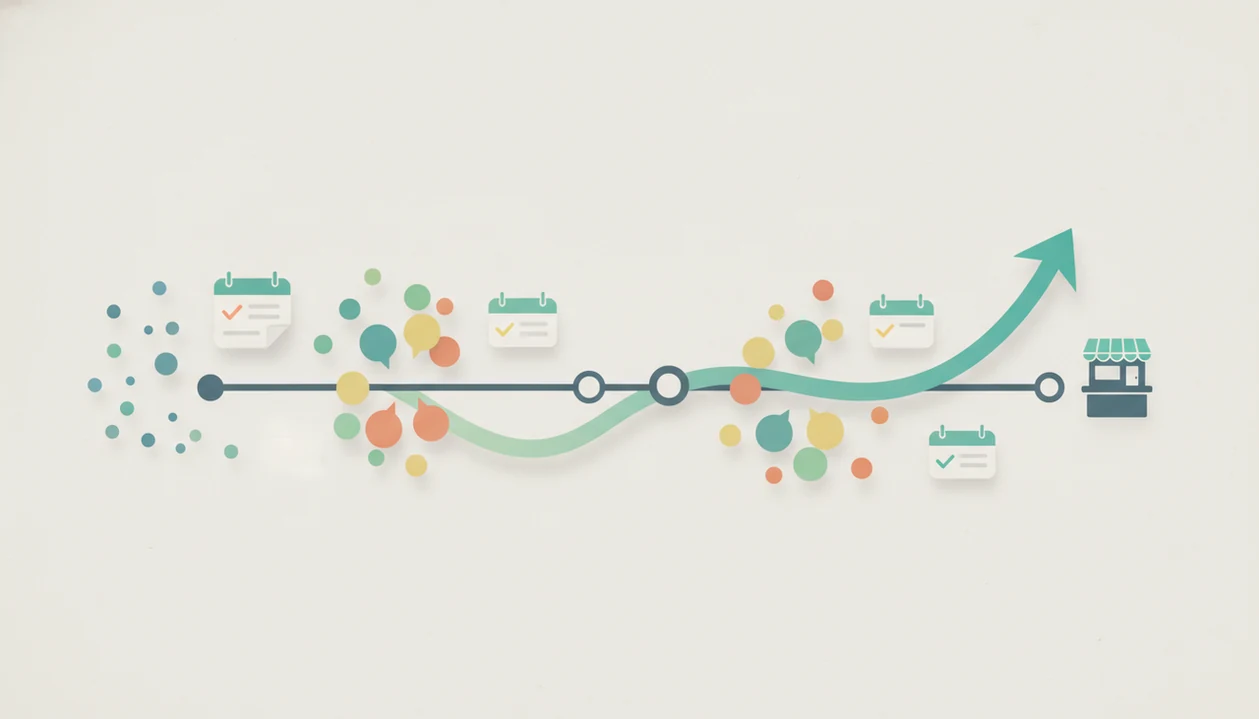
An NPS results timeline becomes useful in stages: first responses can flag urgent issues within days, a first directional score usually appears after one to four weeks, and real trend confidence often needs a full quarter or repeated survey cycles. Small businesses should separate “early signal” from “reliable trend” so they do not overreact to a handful of responses.
Definition: An NPS results timeline is the expected path from first Net Promoter Score responses to a stable score and repeatable customer sentiment trend.
TL;DR
- Use the first week for comments, detractor follow-up, and obvious service issues, not major strategy decisions.
- Use the first month for a directional NPS read if response volume is reasonable and the customer mix is representative.
- Use the first quarter to compare waves, spot NPS trend timing, and decide whether the score is improving or just fluctuating.
At-a-glance NPS results timeline for small businesses
The practical NPS results timeline starts with service recovery, then moves toward score reading, then trend confidence. A shop owner checking yesterday’s survey comments before opening the register should look for fixable issues first, not a boardroom-level metric.
| Timeline stage | What to trust | What not to overstate |
|---|---|---|
| First 1-7 days | Comments, urgent complaints, detractor follow-up | The overall NPS score |
| Weeks 2-4 | Directional score if responses and customer mix look reasonable | A permanent loyalty trend |
| Months 2-3 | Movement across promoters, passives, and detractors | Exact causes without reading comments |
| Quarterly and beyond | Repeated patterns across survey waves | Benchmarks that do not fit your customer base |
For most small businesses, the first week answers “who needs a reply?” The first month answers “where might sentiment be leaning?” The first quarter answers “is this pattern repeating?”
Before you start: NPS timeline prerequisites
Before reading an NPS timeline, set the rules for what you are measuring and who will act on the answers. These choices keep early responses from being mistaken for a clean trend.
- Decide whether the survey is transactional or relational before the first send. A post-delivery question and a quarterly loyalty question can both use NPS, but they should not be judged on the same timeline.
- Define the customer segment you will compare over time. New buyers, repeat customers, wholesale accounts, and support users may move differently, so label the group before comparing one wave with the next.
- Choose one primary send channel and cadence for trend reading. Email, SMS, QR code, and receipt links can attract different respondents, and irregular timing can make normal movement look like a real shift.
- Set a minimum response count for decisions. Below that line, use comments and follow-up notes, but avoid changing policy based on the score alone.
- Assign detractor follow-up before surveys go out. Someone should know who replies, how fast, and what gets logged.
How the NPS results timeline works behind the score
An NPS results timeline works by turning individual 0-to-10 loyalty ratings into groups, then watching how those groups change across repeated survey cycles. Promoters score 9-10, passives score 7-8, and detractors score 0-6.
NPS is calculated by subtracting the percentage of detractors from the percentage of promoters, so the score ranges from -100 to +100. That promoter/passive/detractor grouping and subtraction formula matches Bain & Company’s Net Promoter System explanation: https://www.netpromotersystem.com/about/measuring-your-net-promoter-score/. The mechanics are simple, but the interpretation is not. In a small sample, one unhappy customer can move the percentage sharply.
That’s the trap.
NPS is a lagging sentiment indicator. It reflects experiences customers already had, such as a late delivery, a rushed checkout, or a support issue that ended badly. If you need the formula details, the full math is covered in our guide on how to calculate NPS.
When NPS becomes useful after first responses
“When NPS becomes useful?” It becomes useful almost immediately for follow-up, but it usually needs more responses and repeated cycles before the score itself deserves much weight.
First responses are useful because they tell you what happened in customers’ own words. A customer may say “everything was fine” in person, then give a 6 out of 10 later because the line was slow beside the card reader. That private answer is still recoverable.
A first NPS score is only a directional snapshot. It can point toward concern, but it should not drive a pricing change, staffing change, or product decision by itself. Stable interpretation usually comes from repeated waves, not a single send.
For small businesses, NPS usually works best as a repeated listening habit, while one-time surveys fit quick incident checks.
How to use an NPS results timeline in your survey plan
Use an NPS results timeline by deciding what moment you are measuring, keeping the send pattern consistent, and reviewing comments before acting on the score. Good customer feedback survey apps for small businesses collect post-purchase surveys, NPS scores, and actionable customer insights, not a pile of disconnected charts.
1. Set the NPS question and customer moment
Choose transactional NPS after a purchase, delivery, onboarding step, or support resolution. Choose relational NPS when asking about overall loyalty to the business.
2. Send surveys on a consistent cadence
Pick a trigger or schedule and keep it steady. A receipt link printed below the total is easier to manage than a random batch every few months.
3. Log responses, score, and comments
Record the response count, NPS score, customer segment, and open-text comment in one place.
4. Review detractors before trends
Read low-score comments before declaring a score problem. A private comment is different from a one-star public review.
5. Compare waves before changing strategy
Compare at least two or three waves before changing policy. Tools like Customer Feedback Surveys, SurveyMonkey, and Google Forms can support different parts of this workflow.
NPS trend timing for transactional and relational surveys
NPS trend timing depends on whether the survey is transactional or relational. Transactional NPS can become useful sooner because it is tied to a specific event, while relational NPS needs a wider view of loyalty.
| Survey type | Common timing | What it tells you | Trend caution |
|---|---|---|---|
| Transactional NPS | After purchase, onboarding, delivery, or support resolution | How that moment felt | Do not treat it as full loyalty |
| Relational NPS | Quarterly or biannually; relational NPS is usually run on a periodic cadence rather than after one transaction, as explained by Delighted: https://delighted.com/blog/transactional-vs-relational-nps-surveys | Overall relationship health | Needs repeated waves |
| Mixed programs | Both event-based and scheduled sends | More context | Label scores separately |
A delivery confirmation email after lunch can catch a fresh reaction. A quarterly loyalty survey asks a different question. Do not blend those scores into one trend unless the labels stay visible.
For survey selection, our NPS surveys guide explains common small-business formats.
Small sample volatility in the NPS results timeline
Small sample volatility is the main reason an NPS results timeline can mislead a small business. A low-volume survey wave may look dramatic even when only one or two customers changed category.
- Very small response counts can make NPS jump or drop sharply.
- Before treating a low-volume NPS wave as stable, check sample size and margin of error; SurveyMonkey’s sample-size calculator shows how confidence level and margin of error change required response counts: https://www.surveymonkey.com/mp/sample-size-calculator/.
- Category movement matters: promoters, passives, and detractors tell a clearer story than the final number alone.
- Customer comments explain whether the swing came from service, product, price, delivery, or timing.
- Avoid declaring a win or crisis after one low-volume wave.
Wrong size circled on packing paper may explain several poor ecommerce comments in a single day. That is useful, but it is not yet a loyalty collapse.
Common NPS results timeline mistakes
The common mistakes come from treating NPS as faster and cleaner than it is. NPS can help a small team focus, but only when the timing and follow-up are disciplined.
First-response overreach: One reply is a customer issue, not a meaningful score.
Single-wave trend claims: One survey wave gives a snapshot. It does not prove NPS trend timing.
Survey fatigue: Sending too often can reduce response quality, especially when the same customers keep getting asked.
Too-early sends: Customers need enough experience to form an opinion before a loyalty question makes sense.
No closed loop: Ignoring comments turns NPS into a scoreboard. The value comes when someone owns the follow-up.
If your team also tracks satisfaction after specific interactions, the NPS vs CSAT comparison can help separate loyalty from immediate service quality.
NPS results timeline verification checklist
Use this checklist before treating NPS movement as decision-ready. A weekly spreadsheet tab with NPS scores, customer quotes, and one assigned follow-up is often enough to start.
For citation-ready reporting, write down the survey date range, response count, customer segment, channel, and any operational event that may have affected the wave. A score without those notes is hard to compare later.
- Check whether the response count is large enough for the decision being made.
- Confirm that the same customer group is being compared over time.
- Separate score movement from comment themes.
- Look for repeated promoter, passive, and detractor patterns.
- Use Customer Feedback Surveys to collect post-purchase surveys, NPS scores, and review follow-ups for small businesses.
For a small business, a stable NPS trend is more credible when the same customer segment moves in the same direction across repeated waves.
Limitations
NPS timing helps with interpretation, but it cannot prove everything a business wants to know. The score is useful only when paired with comments, context, and follow-up.
- NPS is a lagging indicator and often reflects experiences that already happened.
- Low response counts can make the score unreliable.
- Fast cadences can create survey fatigue and lower response quality.
- Transactional NPS does not replace relational NPS for overall loyalty.
- NPS alone does not explain why customers feel the way they do.
- Benchmarks may not apply to a small business with a different customer mix.
- Channel differences matter. SMS, email, QR code, and receipt links may attract different respondents.
Customer Feedback Surveys can help organize score, comments, and follow-up, but the business still has to decide what changed on the floor, in the inbox, or at the counter.
FAQ
When is NPS useful?
NPS is useful within days for qualitative follow-up and detractor recovery. Score confidence usually needs more responses and repeated survey waves.
How fast do NPS results arrive?
NPS responses can arrive within hours or days after a survey is sent. The first score may appear quickly, but it may not be stable.
What is NPS trend timing?
NPS trend timing is the period needed to see repeatable score movement across survey cycles. It usually depends on response count, cadence, and customer mix.
Is one NPS survey enough?
One NPS survey can provide a snapshot of current sentiment. It does not prove a trend by itself.
How often should NPS run?
Transactional NPS can run after key events such as purchases, deliveries, onboarding, or support resolutions. Relational NPS is commonly sent quarterly or biannually.
How many NPS responses matter?
More responses generally reduce volatility, especially for small businesses with low customer volume. Very small response counts can make the score swing too much.
Can NPS change overnight?
NPS can change overnight when the sample is small. Meaningful customer sentiment usually changes over longer periods and repeated experiences.