

> Definition: A post purchase survey app is ecommerce software that automatically sends short surveys after checkout or delivery to collect customer feedback on marketing attribution, product quality, and fulfillment experience.
- Dedicated ecommerce survey apps outperform generic form tools because they connect responses to orders, channels, and revenue automatically.
- Post-delivery surveys, not just post-checkout surveys, catch packaging, carrier, and unboxing problems that never appear in transaction data.
- Short surveys under 10 questions triggered at the right moment can achieve 20% response rates for small stores.
At A Glance: Best Post Purchase Survey Apps Compared
Choose a post purchase survey app based on whether you need attribution, NPS, delivery feedback, or a simple recovery workflow. Stores that only ask “How did you hear about us?” need a different setup than stores trying to catch damaged packaging before a one-star review appears.
| App | Best for use case | Platform support | NPS capability | Starting price tier | Post-delivery support |
|---|---|---|---|---|---|
| Customer Feedback Surveys | Small-store feedback, NPS, review follow-up | Ecommerce and local business workflows | Yes | Small-business tier | Yes |
| Fairing | Post-checkout attribution surveys | Shopify and ecommerce stack integrations | Limited by setup | Paid ecommerce plans | Mostly post-checkout |
| KnoCommerce | Attribution and multi-question buyer research | Shopify, Klaviyo, ad stack integrations | Yes | Paid ecommerce plans | Some lifecycle options |
| Grapevine Surveys | Simple Shopify post-purchase questions | Shopify | Basic survey scoring | Low-cost Shopify plans | Mostly post-checkout |
| Triple Whale survey tool | Attribution inside analytics reporting | Shopify, Triple Whale suite | Not the main focus | Free or bundled | Mostly post-checkout |
Good customer feedback survey apps deliver tied-to-order answers and recovery prompts, not a pile of anonymous form responses.
What Post Purchase Survey Software Does
Post purchase survey software turns a short customer answer into useful store data. Instead of leaving feedback as an anonymous comment, it connects the response to the order, product, customer record, and revenue behind it.
A good system can ask about attribution, NPS, fulfillment, product quality, and whether the customer is likely to leave a review. The timing matters. Checkout is useful for “how did you hear about us?” Delivery is better for packaging, carrier, and product-condition questions. Review follow-up is where happy customers can be invited forward and unhappy customers can be handled privately before frustration turns public.
A simple weekly workflow usually looks like this:
- Capture the right moment: Ask attribution after checkout, delivery questions after arrival, and review-intent questions after the customer has used the product.
- Attach answers to context: Keep the score, comment, SKU, order value, and customer details together.
- Route low scores quickly: Send detractors or damaged-order complaints into a recovery task.
- Review patterns weekly: Look for repeated product, carrier, channel, or packaging issues a small team can fix without research software.
5 Facts About Post Purchase Survey Software Every Store Owner Needs
Post purchase survey software works best when it connects customer comments to the order, product, and channel that created the experience. A paper bag stamped with a feedback prompt can help, but order-level data is what turns comments into decisions.
- Ecommerce integrations tie survey responses to orders, products, customer records, and often ad platforms, so a complaint is not floating loose in a spreadsheet.
- Short, mobile-friendly surveys often reach 10% to 20% response rates when they are timed around checkout, delivery, or a review follow-up. For general response-rate context, SurveyMonkey notes that length, timing, audience, and incentives strongly affect completion rates: https://www.surveymonkey.com/mp/survey-response-rates/.
- In the U.S. Chamber’s small-business research, 85% of small employers use at least one digital platform, so cloud survey tools fit how many stores already work. Source: https://www.uschamber.com/small-business/small-business-data-center.
- Connecting NPS and comments to retention, repeat purchase rate, and lifetime value matters more than watching average scores move by one point.
- Bain-linked retention research often cited by Harvard Business Review found that increasing retention by 5% can raise profits by 25% to 95%. Source: https://hbr.org/2014/10/the-value-of-keeping-the-right-customers.
For stores still defining the basics, our guide to post purchase surveys covers common question types and when to ask them.
The quiet client matters.
How Post Purchase Survey Apps Work Behind The Scenes
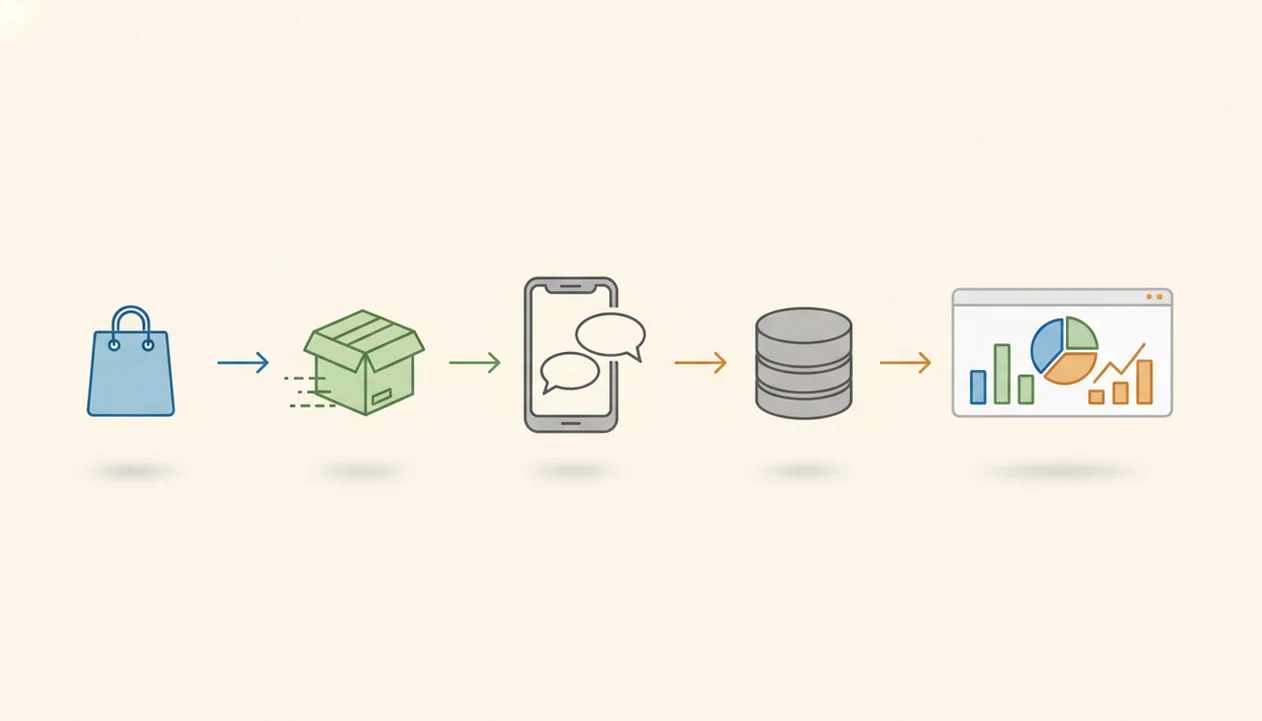
Post purchase survey apps work by listening for ecommerce trigger events, then writing the customer’s answer back to the order or customer record. The main technical idea is event-based automation, which simply means the survey fires when something specific happens.
Common triggers include order confirmation, shipping notification, delivery confirmation, and review follow-up timing. A receipt link printed below the total may collect feedback in-store, while an ecommerce store may send a delivery survey two days after carrier confirmation.
Behind the scenes, attribution questions map self-reported answers to channels and campaigns. “How did you hear about us?” can be tagged as TikTok, Google, influencer, referral, or retail walk-in. NPS questions calculate the score by grouping customers as promoters, passives, or detractors.
Generic form builders like google.com/forms can collect answers, but they usually miss order context. Ecommerce-specific post purchase survey software keeps the response, SKU, order value, and customer segment in the same workflow.
For small stores, Customer Feedback Surveys fits when the owner wants NPS, open-text comments, and review follow-up connected to one practical dashboard.
How To Set Up A Post Purchase Survey App For Your Store
Set up a post purchase survey app by choosing the moment you want feedback, connecting the ecommerce platform, and reviewing answers on a weekly rhythm. The first launch should be simple enough that someone can check it before opening the register.
- Pick your trigger point: Use post-checkout for attribution, post-delivery for fulfillment and product quality, or both for a fuller picture.
- Install the app: Connect it to Shopify, WooCommerce, BigCommerce, or your ecommerce platform so responses attach to orders.
- Choose your questions: Start with attribution, NPS, fulfillment, product quality, and one open “why?” follow-up.
- Set display rules: Control timing, device, order type, customer segment, and whether the survey appears by email, SMS, QR code, or in-app prompt.
- Review responses weekly: Look at the dashboard, tag recurring issues, and connect feedback to customer segments.
If you need the mechanics in more detail, the setup path in how to send survey after online order is built for a first launch.
For small retailers who need feedback without building a research process, Customer Feedback Surveys handles the basic launch through post-purchase surveys, NPS scoring, and customer comment review.
How We Picked The Best Post Purchase Survey Apps
We selected these post purchase survey apps by looking at integration depth, timing options, feedback quality, and whether a small team can act on the results. A founder checking yesterday’s survey comments before opening the register needs clarity, not a dashboard that takes a consultant to explain.
The core criteria were ecommerce platform support for Shopify, WooCommerce, and BigCommerce; post-delivery survey support; NPS and qualitative follow-up in the same workflow; and reporting that connects feedback to channels, products, and revenue. Pricing mattered too. A store printing return labels beside scissors should not need an enterprise contract to learn why customers are sending items back.
Customer Feedback Surveys earned a place for small businesses because it keeps NPS, post-purchase comments, and review follow-ups close to daily operations. Fairing and KnoCommerce scored higher for attribution-heavy teams.
For most stores, the right app depends more on feedback timing than feature volume because checkout, delivery, and reordering answer different questions.
Customer Feedback Surveys: Best Ecommerce Feedback App For Small Stores
Customer Feedback Surveys is a customer feedback survey app that collects post-purchase surveys, NPS scores, and review follow-ups for small businesses. It is strongest for stores that want a manageable feedback workflow rather than enterprise market research software.
- Post-purchase surveys: Ask customers about the buying experience, product fit, delivery, or support while the order is still fresh.
- NPS plus “why?” follow-up: Capture the score, then ask for the reason behind a 9, a 6, or a 2.
- Review follow-up: Route happy customers toward a review request and send low scores into private recovery.
- Small-business dashboard: Keep weekly NPS scores, customer quotes, and one assigned follow-up in view.
For owners who need to close the loop after a quiet complaint, Customer Feedback Surveys fits because low scores can be paired with a comment and a follow-up task.
It is not built for advanced multi-touch attribution modeling. Stores spending heavily across paid social, affiliates, influencers, and retail media may need Fairing, KnoCommerce, or a broader analytics stack beside it.
Fairing And KnoCommerce: Best Post Purchase Survey Software For Attribution
Fairing and KnoCommerce are strong post purchase survey software choices when attribution is the main job. They help stores ask buyers how they first heard about the brand, then connect that answer to order value and marketing analysis.
- Fairing: Fairing is known for post-checkout surveys that tie “How did you hear about us?” answers to revenue. It suits teams comparing TikTok, Meta, podcast, influencer, and word-of-mouth performance.
- KnoCommerce: KnoCommerce is useful for multi-question attribution flows, buyer motivation research, and customer segmentation. It also fits stores using Klaviyo and ad platform integrations.
- Best-fit stores: These tools are a better match for ecommerce teams spending heavily on paid social, creator campaigns, and blended acquisition reporting.
The awkward moment is real: a customer says “everything was fine” in person, then gives a 6 out of 10 later. Attribution tools may explain where that customer came from, but they may not explain what went wrong in the box.
For marketing-led teams, Fairing or KnoCommerce often beats a generic survey form because the attribution answer stays connected to revenue.
Grapevine Surveys And Triple Whale: Best Free Or Low Cost Survey Apps
Grapevine Surveys and Triple Whale are useful for stores that want a post purchase survey app without adding a large monthly cost. They are good starting points when the first goal is collecting answers, not building a full feedback program.
- Grapevine Surveys: Grapevine Surveys is a Shopify App Store option for simple post-purchase questions, basic survey collection, and quick setup. It works well for merchants who want fewer settings.
- Triple Whale survey tool: Triple Whale offers a free survey tool that fits inside its broader analytics suite. It is most useful when a store already looks at attribution and performance data there.
- SEA Post Purchase Survey & Quiz: SEA is another Shopify-native alternative for basic post-purchase collection and quiz-style questions.
Free and low-cost tools can be enough for a first month. However, they often have fewer integrations, lighter dashboards, and limited post-delivery triggers.
If budget is the main constraint, compare the practical tradeoffs in our free post purchase survey app guide before choosing a low-cost option.
Common Drawbacks In Post Purchase Survey Apps
Post purchase survey apps can reveal useful patterns, but every tool has blind spots. Self-reported answers are shaped by memory, mood, and what the customer thinks the store wants to hear.
Small sample sizes can also mislead. If only nine customers answer after a busy weekend, one angry delivery comment can make the whole channel look broken. Brunch crowd beside the espresso machine, three delayed orders, one sharp survey response. Context matters.
No survey app replaces robust analytics, cohort reporting, or multi-touch attribution modeling. Free tools often collect post-checkout feedback only, which means they miss packaging damage, carrier delays, and unboxing issues. Attribution-focused products can also overemphasize marketing and underweight fulfillment.
Customer Feedback Surveys is a better fit when service recovery and NPS matter as much as channel attribution because low-score comments can become follow-up work.
For delivery-specific problems, a product feedback survey after delivery is usually more useful than a checkout-only question.
Limitations
Post purchase survey apps are practical, but they are not a complete truth machine. Use them as one operating signal beside sales data, reviews, support tickets, and repeat purchase behavior.
- Survey data is self-reported, so recall bias and social desirability bias can shape answers.
- Response rates vary widely; a small or unrepresentative sample can point the team in the wrong direction.
- No survey app fully replaces behavioral analytics, pixel tracking, media mix modeling, or multi-touch attribution tools.
- Post-checkout surveys miss delivery, packaging, carrier, and unboxing problems entirely.
- Incentivized surveys can skew answers toward deal-seekers or customers mainly motivated by discounts.
- Connecting survey data to lifetime value often requires manual or semi-manual work in spreadsheets, CRMs, or analytics tools.
- Short surveys improve completion, but they sacrifice depth and may miss nuanced product feedback.
- Tools like typeform.com, jotform.com, and surveymonkey.com can collect polished surveys, but they may need extra setup to connect answers to orders.
For stores that want to measure whether the habit is working, compare comments and repeat issues against a results after 30 days feedback program.