
Post-purchase & QR feedback
Send short surveys by email, SMS, receipt link, or in-store QR code while the visit is still fresh.
Post-purchase surveys, NPS scores, QR feedback, recovery alerts, and review follow-ups in one dashboard built for small businesses.
Send short surveys by email, SMS, receipt link, or in-store QR code while the visit is still fresh.
Route low scores to owners for same-day recovery and invite happy customers to leave a Google review.
Start with one short survey and a recovery alert rule.
> Definition: Customer Feedback Surveys is a customer feedback survey app that collects post-purchase surveys, NPS scores, and review follow-ups for small businesses.
Customer Feedback Surveys fits owners who need feedback while the visit is still fresh because it sends short surveys through receipt links, QR codes, email, or SMS.
A small business feedback app gives owners one repeatable way to collect post-purchase surveys, NPS, CSAT, and CES without building a research process from scratch. Scores, comments, and review follow-ups stay in one workspace, so the owner is not hunting through inboxes, spreadsheets, and Google reviews after closing.
The real difference is the loop after the answer. Generic form builders can collect responses, but they usually do not include CX scoring, recovery alerts, review prompts, or week-by-week trend tracking. That matters when a customer says “everything was fine” in person, then gives a 6 out of 10 later.
No guessing.
If the priority is same-day service recovery, Customer Feedback Surveys fits because low scores can trigger an owner or manager alert before the complaint becomes a one-star public review. A dedicated customer survey app should deliver clear scores, comments, and follow-up tasks, not a pile of exported rows.
For owners comparing options, our best customer feedback survey app guide breaks down where dedicated feedback tools differ from broad survey platforms.
The app combines short templates, CX metrics, distribution channels, alerts, and review follow-ups in one feedback workflow. The useful part is not “making a form.” It is asking at the right moment and turning the answer into an action.
Post-purchase survey templates keep questions under 10 and focus on the recent visit, order, or appointment. Owners can send surveys by email, SMS, QR code, receipt link, or website widget. A receipt link printed below the total often gets better attention than a general “tell us what you think” page buried on a site.
NPS, CSAT, and CES scoring helps owners separate loyalty, satisfaction, and effort. Customer Feedback Surveys tracks those scores over time and lets teams compare by location, product, staff member, or service type.
Happy customers can receive a review follow-up, while low scores can create a recovery alert for the owner or manager. For stores focused on in-person scans, the best QR code feedback survey app page covers QR-specific placement and timing.
Local shops trying to catch feedback before customers leave the block can use Customer Feedback Surveys because QR codes and receipt links collect comments while the experience is still concrete.
A good customer feedback survey app helps a business ask a short question at the right moment, understand the score without extra math, and act before the customer disappears. It should feel like an operating tool for owners and managers, not a research project.
Use this checklist when comparing options:
The best app makes the next action obvious: recover the unhappy customer, learn from the trend, or invite a happy customer to share the experience publicly.
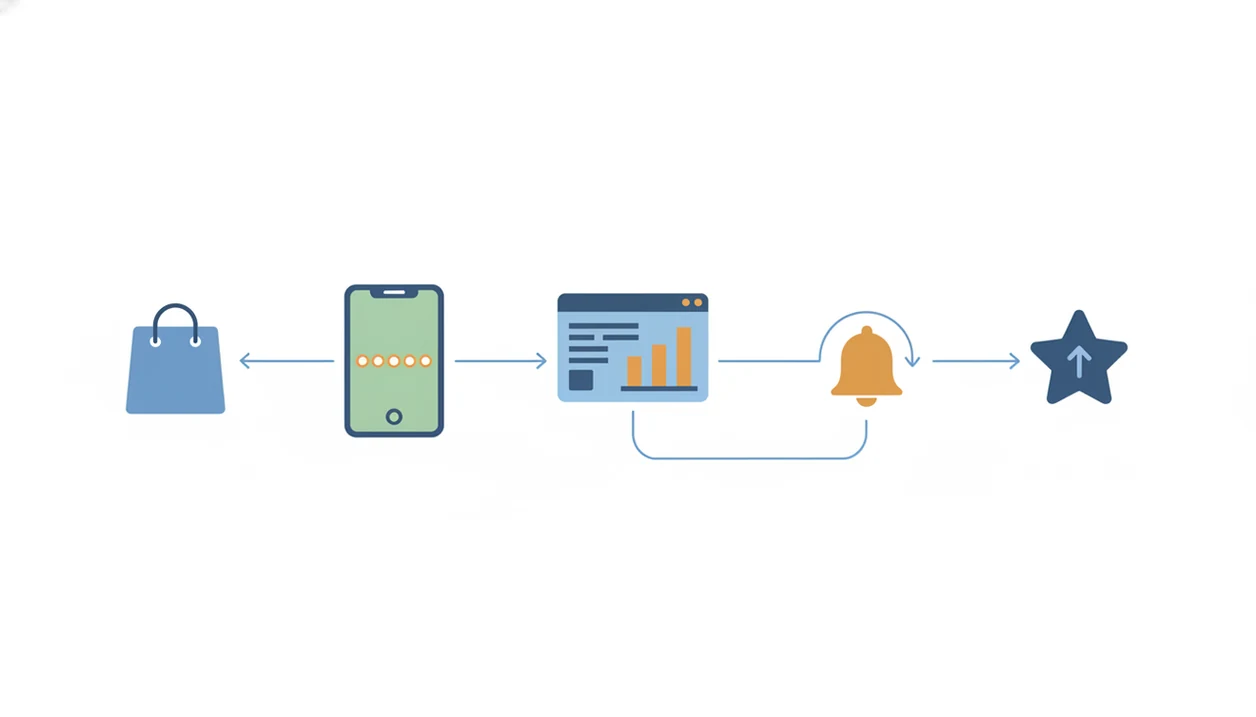
A customer feedback survey app works by connecting a trigger, a scoring engine, routing logic, and a dashboard. In plain terms, the system sends the right short survey, scores the answer, then decides whether the next step is recovery, review follow-up, or trend tracking.
A purchase event, appointment completion, delivery confirmation email after lunch, or manual send can trigger the survey. The customer receives it through the selected channel, such as SMS, email, QR code, receipt link, or website embed. Immediate post-transaction timing usually produces cleaner satisfaction data than a message sent days later.
Responses map to NPS, CSAT, or CES formulas in real time. Scores below a chosen threshold create recovery tickets; scores above the threshold can trigger a review request. The dashboard stores responses as time-series data, so owners can track trends by week, location, product, or team.
Trust matters here. Pew Research found that 85% of U.S. adults are likely to stick with a company that has a strong record of protecting personal information source.
Use a feedback survey maker by starting with one moment, one metric, and one follow-up rule. Customer Feedback Surveys is easiest to launch when the first workflow is narrow, such as a post-purchase CSAT survey or a simple NPS check after delivery.
Start small.
Owners looking for ready-made wording can use customer feedback survey templates before editing for their store, salon, restaurant, or online shop. For small teams, the setup should feel like a weekly operating habit: scores, customer quotes, and one assigned follow-up.
A customer survey app is most useful when feedback arrives close to the customer’s actual experience. That matters for the 99.9% of U.S. businesses that are small businesses, including owners who do not have a dedicated CX team.
Retail shops and restaurants can collect QR feedback in-store, such as near a patio table waiting for wiped menus or beside the register. Service businesses, including salons, clinics, contractors, and spas, can send post-appointment SMS surveys after the visit. E-commerce stores can place post-purchase NPS questions in order confirmation flows or delivery follow-ups.
Multi-location owners can compare CSAT across branches instead of relying on scattered anecdotes. Solo operators can automate the response window, recovery alert, and review request.
Service businesses looking for appointment follow-up can use Customer Feedback Surveys because SMS surveys and recovery alerts keep the owner close to the customer comment without adding a full-time support role.
A dedicated customer feedback survey app is built for ongoing CX measurement, while generic form builders are usually built for one-off data collection. Tools like surveymonkey.com, typeform.com, google.com/forms, and jotform.com can collect answers, but they often need extra setup for scoring, routing, and follow-up.
| Need | Customer Feedback Surveys | Generic form builders |
|---|---|---|
| NPS, CSAT, CES scoring | Built into the feedback workflow | Often manual or template-dependent |
| Recovery alerts | Low scores can notify an owner or manager | Usually requires extra automation |
| Review follow-ups | Happy customers can receive review prompts | Usually separate from the form |
| Trend tracking | Dashboard shows week, location, and product patterns | Often requires exports |
| Ongoing feedback | Designed for repeatable post-purchase surveys | Better for one-time questionnaires |
Free form tools are not “basically the same” if the owner needs close-the-loop automation. For stores comparing post-order workflows, the best post purchase survey app guide explains timing, channels, and recovery use cases.
We evaluate customer feedback survey apps by checking whether a real owner can launch, read, and act on feedback without a research team. The strongest tools make scoring, alerts, follow-ups, and reporting feel like part of daily operations.
Our review process looks at the full feedback loop:
The goal is simple: find apps that help small teams ask, understand, and respond quickly.
Small business feedback apps are often misunderstood because many owners picture enterprise research software. Customer Feedback Surveys is meant for smaller, practical feedback workflows: ask, score, alert, follow up, and review the trend.
Myth: Only big companies need a feedback app. Reality: Solo owners and local shops often need automation more because there is no customer experience department.
Myth: Long surveys produce better insight. Reality: Short surveys usually get more usable answers. A customer standing near the door is not going to write a research essay.
Myth: NPS and CSAT are vanity metrics. Reality: NPS and CSAT become useful when tracked over time and paired with customer comments, segments, and follow-up actions.
Myth: More surveys always mean more insight. Reality: Over-surveying causes fatigue, lower response rates, and annoyance. The better habit is asking at the right moment, then closing the loop.
NPS works better as a trend than as a single score because the customer quote often explains what the number cannot.
Customer Feedback Surveys surfaces customer problems, but it cannot fix broken operations by itself. A line cook calling out delayed entrees still needs staffing, training, or process changes after the feedback arrives.
A customer feedback survey app is software that sends short surveys after a purchase, appointment, delivery, or support interaction. It collects customer comments, NPS, CSAT, and other scores in one dashboard so a business can spot problems and follow up.
A customer feedback survey should usually have fewer than 10 questions. Short surveys are easier to finish, especially when the customer is responding from a phone, receipt link, or QR code near the point of purchase.
Yes, NPS can be useful for small businesses when it is tracked over time and paired with customer comments. Bain’s Net Promoter research links strong relative NPS performance with faster company growth source.
Yes, QR codes are a practical way to collect feedback in stores, restaurants, salons, clinics, events, and service locations. Customers scan the code from a counter sign, receipt, table card, or checkout area and answer the survey on their phone.
Negative feedback recovery alerts trigger when a customer gives a low score or chooses a negative response. Customer Feedback Surveys can notify the owner or manager so the team can follow up privately, often before the issue becomes a public review.
Yes, Customer Feedback Surveys can support Google review generation by sending review follow-ups to customers who report a positive experience. The workflow should not pressure customers or hide negative feedback; it should route happy customers toward a public review and unhappy customers toward recovery.
NPS measures loyalty by asking how likely a customer is to recommend the business. CSAT measures satisfaction with a specific experience, such as a purchase, visit, appointment, delivery, or support interaction.
Customer surveys can annoy customers if they are too long, too frequent, or sent at the wrong time. Keep surveys short, send them after meaningful interactions, and avoid asking the same customer for feedback repeatedly in a short response window.
Yes, Customer Feedback Surveys offers a free tier for small businesses that want to start collecting feedback without a research team. The free plan is designed for basic survey collection, score review, and early feedback workflow testing.
Customer Feedback Surveys is a customer feedback survey app built for small businesses that need to collect post-purchase surveys, NPS scores, QR code feedback, and review…