
Customer Feedback Survey Compliance for Small Businesses

Quick answer: Customer feedback survey compliance means collecting post-purchase surveys, NPS scores, review requests, and free-text feedback in a way that respects consent, privacy, message-delivery rules, vendor access, and data retention. For small businesses, the safest baseline is clear notice, limited data collection, easy opt-outs, controlled access, and a written retention process.
> Definition: Customer Feedback Surveys is a customer feedback survey app that collects post-purchase surveys, NPS scores, and review follow-ups for small businesses.
TL;DR
- Survey compliance covers more than survey questions: it includes email, SMS, consent, privacy notices, storage, sharing, deletion, and vendor handling.
- Free-text feedback can become personal data when customers include names, contact details, complaints, health details, financial details, or other identifying information.
- Small businesses should treat feedback surveys as a trust workflow: collect only what is needed, explain the purpose, honor opt-outs, limit internal access, and delete old responses on a schedule.
Customer Feedback Survey Compliance at a Glance
Customer feedback survey compliance covers the rules and operating habits behind post-purchase surveys, NPS surveys, customer satisfaction surveys, email requests, SMS requests, review follow-ups, and stored responses. It is not only about whether a question sounds polite.
The practical baseline is simple to say and harder to maintain: tell customers what you collect, why you collect it, who can access it, how opt-outs work, and how long responses stay on file. Requirements can change by country, state, industry, channel, and data type.
A receipt link printed below the total feels harmless until a customer writes their phone number, a medical detail, or a staff complaint in the comment box.
Small businesses should treat survey compliance as an everyday feedback workflow, not a one-time checkbox. This page is educational only and is not legal advice.
Five Customer Feedback Privacy Rules Small Businesses Should Know
- Survey compliance includes the whole lifecycle. Collection, storage, access, sharing, analysis, exports, and deletion all matter, not just the wording of the survey.
- Consent, notice, and purpose matter. A post-purchase survey can collect personal data through contact details, transaction details, location, or identifiable free-text comments.
- Email and SMS have their own rules. A survey link sent by email or text may trigger opt-out, sender identity, or messaging consent obligations, even if it is not a coupon blast.
- Data minimization reduces avoidable risk. Ask only what helps improve service, NPS tracking, product feedback, or review follow-up because customers often disclose more than expected.
- Vendors are part of the privacy chain. Survey apps, email tools, SMS providers, CRMs, analytics dashboards, and AI sentiment tools may each process customer comments.
The quiet risk is the comment box. People use it like a note to the owner.
Customer Feedback Survey Data Flow Behind the Scenes
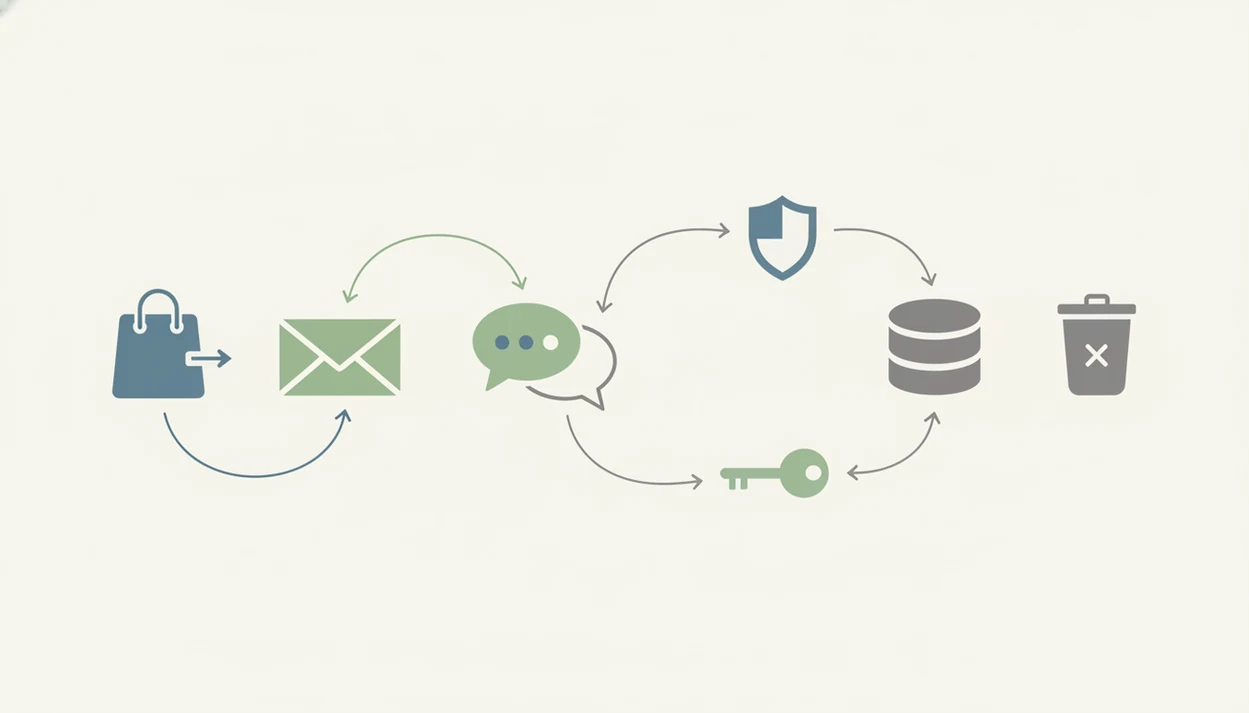
A customer feedback survey works by moving customer data through a chain: transaction, survey trigger, email or SMS delivery, response collection, metadata capture, dashboard analysis, follow-up, export, retention, and deletion. That chain is the real compliance workflow.
Risk increases when feedback is linked to identities, order histories, phone numbers, email addresses, store locations, support tickets, review requests, AI sentiment tools, or CRM records. A support ticket linked to a low rating can be useful for service recovery, but it also joins two data sets that were once separate.
How customer feedback survey compliance works: the business defines the purpose, notice, access rules, and retention period; the tool processes data according to those settings. The technical terms are data mapping and access control. In plain English, know where the response goes and who can open it.
A good customer feedback survey app for small businesses should collect post-purchase surveys, NPS scores, and actionable customer insights, not make legal decisions for the business.
Survey Compliance Rules for Email and SMS Requests
Email and SMS survey requests create compliance duties separate from the survey form itself. The message that carries the survey link can be regulated even when the survey has only one question.
| Channel | Common controls | Main risk |
|---|---|---|
| Email survey request | Sender identity, accurate subject line, physical mailing address where applicable, unsubscribe or opt-out path | Commercial email rules may apply |
| SMS survey request | Prior consent review, clear sender, opt-out wording, limited frequency | Texting can carry higher consent and statutory damages risk |
| Mixed promotional survey | Separate survey purpose from discounts or review pushes | A feedback request may become marketing |
Email survey request controls
The FTC's CAN-SPAM guidance says recipients have the right to opt out of future commercial emails, and businesses must honor opt-out requests within 10 business days (FTC: https://www.ftc.gov/business-guidance/resources/can-spam-act-compliance-guide-business). For channel-specific basics, the question is it legal to email feedback surveys deserves a separate review.
SMS survey request controls
SMS requests can be riskier because texts are more intrusive. Under the TCPA, statutory damages can be $500 per violation, with possible increases to $1,500 for willful or knowing violations (47 U.S.C. § 227: https://www.law.cornell.edu/uscode/text/47/227). Keep transactional survey requests separate from promotional campaigns when possible.
Customer Feedback Privacy Rules for Data, Access, and Retention
Customer feedback privacy rules require a business to collect only the feedback and identifiers needed for a clear purpose, then control who can view, use, export, and delete that data.
Data minimization means asking only what helps improve the purchase experience, service quality, NPS tracking, or review follow-up. A three-question CSAT survey after delivery usually needs less data than a support investigation. The wrong size circled on packing paper may explain the issue without asking for more personal details.
Free-text responses can still contain personal data or sensitive information. Customers may name an employee, include a phone number, describe a health concern, or mention payment trouble.
How to use customer feedback survey compliance in a small workflow:
- Name the purpose before sending the survey.
- Ask fewer questions and avoid sensitive prompts unless necessary.
- Limit access to staff who handle service recovery or reporting.
- Review weekly in a spreadsheet tab with NPS scores, customer quotes, and one assigned follow-up.
- Delete or anonymize older records on a documented schedule.
California’s CCPA/CPRA framework gives consumers deletion rights and generally requires business responses within 45 days (California DOJ: https://oag.ca.gov/privacy/ccpa), which is one reason customer feedback data retention needs an owner.
Common Customer Feedback Survey Compliance Myths
- Myth: “It’s just research.” Reality: a feedback survey can still involve privacy, consent, message-delivery, and retention rules when it identifies customers.
- Myth: “The survey app owns compliance.” Reality: the business usually controls the purpose, notice, questions, follow-up, and retention choices.
- Myth: “Free-text comments are harmless.” Reality: comments can include names, contact details, complaints, health details, or other identifying facts.
- Myth: “An unsubscribe link solves everything.” Reality: opt-outs help with delivery rules, but they do not control storage, sharing, access, or deletion.
- Myth: “Anonymous survey data is always safe.” Reality: timestamps, order numbers, locations, and written details can re-identify a person.
The awkward case is familiar: a customer says “everything was fine” in person, then gives a 6 out of 10 later. That private comment is recoverable, but it still needs careful handling. More detail on anonymous customer feedback helps separate lower-risk surveys from truly identifiable ones.
Compliance Guarantees Small Businesses Should Expect From Survey Vendors
Small businesses should expect survey vendors to support secure data handling, documented subprocessors, access controls, export and deletion tools, opt-out support, audit-friendly settings, and clear data processing terms. Those features help the business run a cleaner feedback workflow.
Vendor oversight should cover more than the survey form. The survey app, email delivery service, SMS provider, CRM, analytics tool, and any AI sentiment analysis system may all touch customer comments. Tools like Customer Feedback Surveys can help collect post-purchase surveys, NPS scores, and review follow-ups, but software does not replace business-specific compliance review.
A vendor cannot guarantee the lawful basis, survey purpose, wording choices, notice accuracy, industry restrictions, or retention policy. The owner still decides whether a review follow-up goes to every happy customer or only to a filtered segment.
For small teams, opt-out support and deletion exports are often easier to check than broad security claims. Ask to see the setting.
Customer Feedback Survey Compliance Boundaries and Exclusions
Does this page make my customer feedback survey compliant everywhere? No. Survey compliance guidance is not a substitute for legal advice, and a compliant setup in one location or channel may fail in another.
This guide does not create a universal GDPR, CCPA, TCPA, CAN-SPAM, HIPAA, financial services, children’s privacy, employment, or international compliance program. It explains small-business practicalities for post-purchase surveys, NPS scores, customer satisfaction surveys, and review follow-ups.
Templates and software settings cannot replace a business-specific review of consent, notices, data use, and retention. A salon follow-up text after a haircut raises different questions than a SaaS in-app NPS prompt after a product release.
For businesses subject to EU law, GDPR maximum penalties can reach €20 million or 4% of annual global turnover for serious violations (GDPR Article 83: https://gdpr-info.eu/art-83-gdpr/). That scale is why GDPR customer feedback surveys should be reviewed separately when EU customers are involved.
When to Get Legal or Privacy Help for Survey Compliance
Get legal or privacy help before a survey crosses into higher-risk messaging, sensitive data, or broad geographic coverage. A short NPS request can still need professional review when the channel, audience, or connected systems change.
Use escalation as a normal operating step, not a sign that the feedback program is broken.
- Check consent with counsel before texting customers a survey link, especially if you cannot show where and when SMS permission was captured.
- Pause sensitive questions when responses may include health, payment, credit, insurance, children’s information, or other data that carries special rules.
- Review coverage before sending surveys to EU customers, California residents, or a multi-state customer list with different privacy rights.
- Ask a privacy specialist before syncing survey responses into a CRM, support desk, advertising audience, warehouse, or AI sentiment tool, because combining systems can change the risk.
- Escalate rights requests when a customer asks to delete, access, correct, or opt out of survey data handling.
The practical test is simple: if one person’s answer could trigger a legal duty, do not leave the decision inside the survey dashboard.
Primary Sources for Survey Compliance Rules
Primary sources for survey compliance rules are the statutes, regulator guides, and enforcement materials that explain the actual duties behind email, SMS, privacy rights, penalties, and remedies. Use them as verification points, then ask counsel how they apply to your business.
- Confirm email basics against the FTC’s CAN-SPAM business guidance for sender identity, commercial email opt-outs, and honoring unsubscribe requests: source.
- Review texting risk under the TCPA statutory text before sending survey links by SMS, especially where consent records are thin: source.
- Check California rights using the state CCPA resources for deletion requests, response timing, and consumer privacy obligations: source.
- Understand EU exposure by reading GDPR Article 83, which sets the penalty framework for serious violations: source.
- Study enforcement remedies in FTC privacy cases, because orders can require operational changes, not just payment: source.
The point is not to turn a shop owner into a lawyer. It is to keep the survey workflow tied to authorities someone can actually verify.
Limitations
There is no single global rulebook for customer feedback survey compliance. The same survey can be low-risk in one channel and higher-risk in another.
- Legal requirements vary by jurisdiction, industry, customer type, communication channel, and data category.
- Compliance tools do not guarantee compliance because the business controls survey purpose, notices, legal basis, follow-up, and retention.
- Anonymization is not always complete protection because free-text answers and metadata can still identify people.
- Email rules, SMS rules, privacy rules, review request rules, and data security obligations may overlap.
- Older survey exports, spreadsheets, CRM copies, and analytics dashboards can create hidden retention risk.
- FTC privacy orders can impose operational restrictions, not only monetary penalties; the 2024 Rite Aid order included a five-year facial recognition ban and other restrictions (FTC: https://www.ftc.gov/news-events/news/press-releases/2023/12/ftc-says-rite-aid-recklessly-used-facial-surveillance-systems-leaving-consumers-facing-humiliation).
- Review requests can raise trust issues if they pressure only happy customers or bury complaints.
The old export folder is easy to forget. It is still data.
If you are comparing channels, the email vs SMS surveys choice should include compliance risk, not just response rate.
FAQ
Are customer surveys personal data?
Customer surveys can contain personal data when responses, contact details, metadata, order details, or free-text comments identify a customer. Even a short NPS survey can become identifiable if it links to an email address or transaction.
Do post-purchase surveys need consent?
Customer feedback surveys may need consent depending on jurisdiction, communication channel, data type, and purpose. SMS outreach and marketing-linked survey requests often require closer consent review.
Can I text customers a survey link?
You can text customers a survey link only if the message fits applicable consent and opt-out rules. In the United States, SMS survey links can create TCPA risk.
Do survey emails need unsubscribe links?
Survey emails may need an unsubscribe or opt-out path if they are commercial or mixed with promotional content. Sender identity and accurate subject lines also matter.
How long should a small business keep survey responses?
A small business should keep survey responses only as long as they serve a documented business need or legal obligation. Identifiable responses usually need a clearer deletion or anonymization schedule.
Are anonymous surveys always compliant?
Anonymous surveys reduce risk, but they are not always fully anonymous. Free text, timestamps, order data, location, or metadata can still identify a customer.
Who is responsible for survey compliance?
The business usually owns survey compliance decisions even when a survey app, email platform, or SMS provider processes the data. Customer Feedback Surveys and similar tools can support workflows, but they do not choose the legal basis or retention policy.
Can customer surveys ask for reviews?
Customer surveys can ask for reviews if the request is transparent, non-misleading, and handled carefully. Review follow-ups should be separated from sensitive complaints or support escalation where possible.
What is survey data minimization?
Survey data minimization means collecting only the feedback, identifiers, and context needed for a clear business purpose. For Customer Feedback Surveys users, that usually means keeping post-purchase surveys short and avoiding unnecessary personal questions.