
Email vs SMS Surveys for Customer Feedback Requests
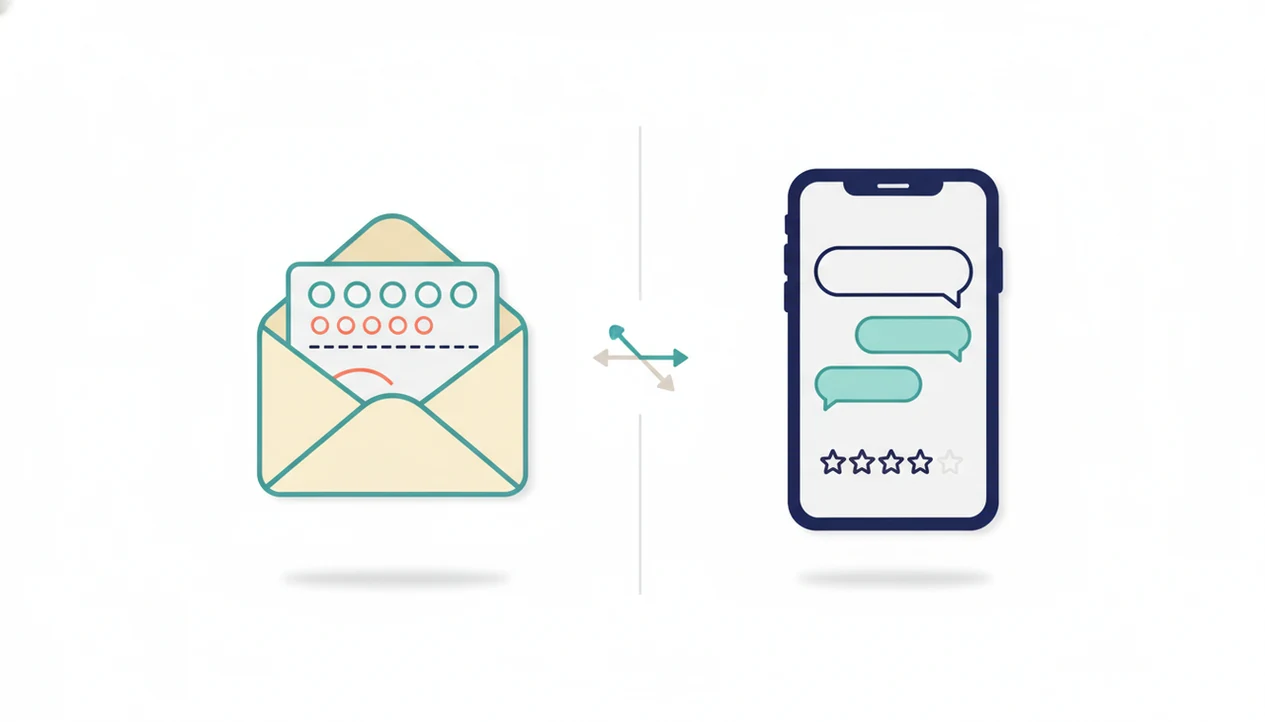
SMS is usually better for fast, short feedback requests; email is better for longer, more detailed customer comments. The right choice in email vs SMS surveys depends on timing, consent, survey length, customer preference, and the cost per actionable response. Customer Feedback Surveys supports both channels so a small business can ask at the right moment without turning every follow-up into a manual task.
Definition: Email vs SMS surveys compares sending customer feedback requests by inbox message versus text message so a business can choose the right channel for post-purchase surveys, NPS scores, and review follow-ups.
TL;DR
- Choose SMS for immediate one-question NPS, CSAT, or post-service feedback when you have clear opt-in.
- Choose email for multi-question surveys, longer comments, segmentation, and lower per-message costs.
- Use both channels carefully when customer preference, timing, and feedback depth matter more than picking one winner.
Email vs SMS surveys, side by side
Side-by-side captures of the compared products. Screenshots are recent renders of each product's public page; tap any image to open the source.
Email vs SMS surveys at a glance
SMS wins on speed; email wins on depth. For many small businesses, the practical answer is not one channel forever, but a channel rule for each customer moment.
| Factor | Email surveys | SMS surveys |
|---|---|---|
| Speed | Slower, often checked later | Faster, usually seen near the moment |
| Reach | Strong for customers who use inboxes | Strong when mobile numbers and opt-in are current |
| Cost | Usually lower per send | Often higher per send |
| Consent | Still needs permission and proper handling | Needs especially careful opt-in and opt-out handling |
| Detail | Better for multi-question surveys | Better for one score and one short comment |
| Response quality | Richer explanations | Faster signals, less context |
| Best use cases | Product diagnosis, B2B, service evaluations | NPS, CSAT, post-appointment checks |
The owner checking yesterday’s survey comments before opening the register usually needs both signals: a quick score and enough words to fix something. Customer Feedback Surveys fits that blended workflow because it can collect post-purchase surveys, NPS scores, and review follow-ups by channel.
How email and SMS survey channels work
Email surveys deliver a branded inbox message with a survey link, embedded rating, or longer form; SMS surveys send a short text prompt, rating request, or link to a mobile-friendly survey. The mechanics are simple, but the response behavior is not.
Email depends on deliverability, sender reputation, subject line clarity, and whether the customer still watches that inbox. SMS depends on phone proximity, opt-in quality, quiet hours, and whether the text feels useful or intrusive. Device context matters too. A customer leaving a salon may answer a one-tap CSAT by text, but not write three paragraphs while standing by the parking meter.
Tiny window. Big difference.
Customer Feedback Surveys handles the small-business version of this workflow: send the right post-purchase survey, capture the NPS or CSAT score, and route positive customers toward a review follow-up when appropriate. Good feedback survey channels deliver timely operating signals, not a research dashboard nobody opens.
Where email surveys win for detailed customer feedback
Email is the stronger channel when the business needs explanation, not just a score. It gives customers enough space to describe what happened, attach context, and answer more than one question.
- Email supports longer surveys, multiple questions, explanation text, conditional logic, and richer customer comments.
- Email usually has lower per-message costs, which helps when sending larger diagnostic follow-ups.
- Email gives more room for branding, order details, service notes, and a clear reason for asking.
- Email works well for B2B feedback, service evaluations, product delivery issues, and customers who prefer inbox communication.
- For reach context, Pew Research Center reports that 95% of U.S. adults use the internet, and 90% own a smartphone (https://www.pewresearch.org/internet/fact-sheet/internet-broadband/; https://www.pewresearch.org/internet/fact-sheet/mobile/). Use a separate dated source if you make a specific claim about email being preferred over text for company contact.
For teams investigating a warehouse shelf with mislabeled bins or a confusing checkout flow, email is often better than SMS because it gives customers room to explain the problem. Customer Feedback Surveys can send those longer follow-ups without mixing them into quick one-question NPS requests.
Where SMS surveys win for fast feedback requests
SMS is the stronger channel when the feedback window is short and the question is simple. It works best when the customer can answer in under 30 seconds.
- SMS fits immediate post-purchase, post-appointment, curbside pickup, repair, hospitality, and service feedback.
- SMS surveys should stay short: one rating question plus one optional open-ended follow-up.
- Phone proximity can produce faster responses because the prompt arrives on the device already in the customer’s hand.
- Message urgency helps, but it can backfire if the business sends too often.
- Pew Research Center reports that 97% of U.S. adults own a cellphone, which supports SMS reach when consent and phone numbers are current (https://www.pewresearch.org/internet/fact-sheet/mobile/).
After a massage room smelling of eucalyptus, when the customer is still deciding whether to rebook, Customer Feedback Surveys fits the moment with a short CSAT text and a private low-score alert. For fast service recovery, SMS tends to work best when the question is brief and the follow-up path is clear.
Cost, consent, and compliance differences in email or text surveys
Email is usually cheaper per message, but cheaper does not always mean more useful. SMS can cost more per send, yet still win when fast replies prevent a one-star public review.
| Issue | Email survey | Text survey |
|---|---|---|
| Send cost | Usually lower | Often higher |
| Main delivery risk | Spam filtering, inbox overload, stale addresses | Bad numbers, opt-outs, carrier filtering |
| Format limit | More room for context | Tight character limits |
| Consent handling | Permission and unsubscribe expectations | Clear opt-in, opt-out language, quiet hours |
| Best cost measure | Cost per completed useful response | Cost per fast actionable signal |
Cost per actionable response combines send cost, completion rate, and depth of insight. A cheap email that nobody opens may cost more than a text that catches a service issue in ten minutes.
For rules and risk questions, use this page as operational guidance, not legal advice. Our customer feedback survey compliance guide covers the broader checklist, and businesses should follow applicable email, privacy, and telecom rules.
How to choose email vs SMS surveys for small business feedback
Choose the channel by matching the customer moment to the answer you need. A short score can travel by text; a careful explanation usually belongs in email.
- Match the survey length to the channel: use SMS for one rating and email for multi-question feedback.
- Check consent before sending, especially for text messages and any review follow-up.
- Choose timing close to the experience, such as after pickup, delivery, checkout, or appointment completion.
- Segment by customer preference when you know whether the person prefers inbox or phone contact.
- Review response quality weekly, not just response count, by comparing scores, comments, and follow-up outcomes.
- Adjust the workflow when one channel produces shallow answers or too many opt-outs.
Customer Feedback Surveys supports practical post-purchase surveys, NPS scores, and review follow-ups for small businesses without overcomplicating the workflow. The weekly spreadsheet tab still matters: NPS scores, customer quotes, and one assigned follow-up.
How to use email and SMS surveys together
Use SMS for the first fast signal and email for the deeper explanation. The goal is a simple sequence that respects permission, catches problems early, and gives the team enough detail to act.
- Start with clean customer records that include email address, mobile number, consent status, and preferred contact channel. If that field is blank, do not guess; use the channel where permission is clearest.
- Send one short SMS question right after time-sensitive experiences, such as checkout, delivery, appointment completion, or pickup. Keep it to a rating plus one optional comment so the customer can answer while the moment is still fresh.
- Use email when the score or situation needs diagnosis, including product issues, staff notes, service details, or longer customer comments.
- Route low scores into a private recovery workflow before any review request goes out. Assign an owner, set a follow-up deadline, and keep the conversation out of public review channels until the issue is handled.
- Review completion quality, opt-outs, unresolved follow-ups, and recovery outcomes every week. If texts create opt-outs or emails produce thin answers, adjust timing, wording, or channel rules.
Best-fit feedback survey channels by customer moment
The best feedback survey channel depends on what just happened. McKinsey reported in 2021 that 71% of consumers expect personalized interactions, which supports tailoring survey channel and timing instead of sending every customer the same request (https://www.mckinsey.com/capabilities/growth-marketing-and-sales/our-insights/the-value-of-getting-personalization-right-or-wrong-is-multiplying).
Post-purchase quick rating: Use SMS if the customer opted in; use email if you do not have text consent. Customer Feedback Surveys handles this through short NPS or CSAT requests tied to the purchase moment.
Detailed product or service diagnosis: Use email when you need the customer to explain a defect, delivery problem, or staff interaction.
Appointment or service visit follow-up: Use SMS first, then email if the score suggests a deeper issue.
Review request after positive NPS or CSAT: Use either channel based on permission and preference, without review gating.
A customer may say “everything was fine” in person and give a 6 out of 10 later. That private comment is still recoverable.
Choose SMS for immediate moments
Use SMS when the experience is fresh and the question is low effort. A receipt link printed below the total can work, but a text may catch the customer before the memory fades.
Choose email for diagnostic follow-up
Use email when the answer needs detail, routing, or internal review. Customer Feedback Surveys can keep the first ask short, then send a deeper follow-up when the score or comment calls for it.
Evidence on email vs SMS survey reach and response behavior
The evidence supports a split decision: email has broad digital reach and room for detail, while SMS has strong mobile reach and usually faster attention. Treat channel statistics by source type and date, not as timeless rules.
Government and independent research is best for reach. Recent Pew figures cited above show very high U.S. internet use, smartphone ownership, and cellphone ownership, which means both inbox and mobile channels can reach many customers when records and consent are current. Vendor claims about SMS open rates or email benchmarks are useful for directional planning, but they measure a provider’s customer base, campaign mix, and time period, not every small business.
Use a simple evidence check before changing workflows:
- Separate reach data from performance claims, especially when a number comes from a vendor report.
- Name the measurement year in internal notes so 2021 personalization behavior is not treated like 2026 survey behavior.
- Compare response speed with response quality; a five-minute text reply can still be too thin to diagnose the problem.
- Calculate cost per completed, actionable response, not just cost per send.
- Review comments, recovery outcomes, and opt-outs together before declaring a channel the winner.
Limitations
Both channels have real tradeoffs. Channel choice can improve timing and response quality, but it cannot rescue a confusing survey or a team that never closes the loop.
- Reported SMS open-rate claims are often vendor-sourced, so treat them as directional rather than universal.
- Neither channel reaches customers without valid consent, accurate contact data, and a clear reason to respond.
- SMS can feel intrusive, especially after hours or after repeated promotional texts.
- Email can be ignored, filtered, or buried below order confirmations and discount campaigns.
- Digital survey results can be biased toward reachable, engaged, or unhappy customers.
- A text survey can capture a quick score, but it may miss the full story behind that score.
- Email can collect rich comments, but longer forms often lose busy customers.
- Customer Feedback Surveys is not a legal compliance service; review questions like is it legal to text feedback surveys with the right internal or professional advice.
- Enterprise platforms such as qualtrics.com, surveymonkey.com, and typeform.com may suit larger research teams better than a lightweight small-business workflow.
No channel fixes silence.
FAQ
Are SMS surveys better than email?
SMS surveys are often faster than email surveys, especially for one-question NPS or CSAT requests. Email is usually better when the business needs detailed customer comments.
Do email surveys still work?
Yes, email surveys still work for engaged customers, B2B buyers, service evaluations, and longer post-purchase surveys. They are especially useful when the customer needs space to explain an issue.
Which survey gets faster responses?
SMS surveys usually get faster responses because texts arrive on the customer’s phone and are easier to answer immediately. Email responses often arrive later, especially outside business hours.
Are text surveys more expensive?
Text surveys often cost more per message than email surveys. The better measure is cost per actionable response, which includes send cost, completion rate, and usefulness of the feedback.
Can SMS surveys ask open questions?
Yes, SMS surveys can ask one brief open-ended follow-up after a rating question. The prompt should stay short so the survey does not feel like a long form inside a text thread.
When should I use email surveys?
Use email surveys for multi-question feedback, product diagnosis, B2B follow-ups, service evaluations, and detailed customer comments. Email is also useful when you need more branding or context.
When should I use text surveys?
Use text surveys for immediate post-purchase feedback, appointment follow-ups, curbside pickup checks, repair updates, and quick NPS or CSAT requests. SMS works best when the customer has clearly opted in.
Can I use both channels?
Yes, many small businesses use both channels by sending SMS for a quick score and email for deeper follow-up when needed. Customer Feedback Surveys supports that kind of practical sequencing for post-purchase surveys, NPS scores, and review follow-ups.