
Can I Ask Only Happy Customers for Reviews?
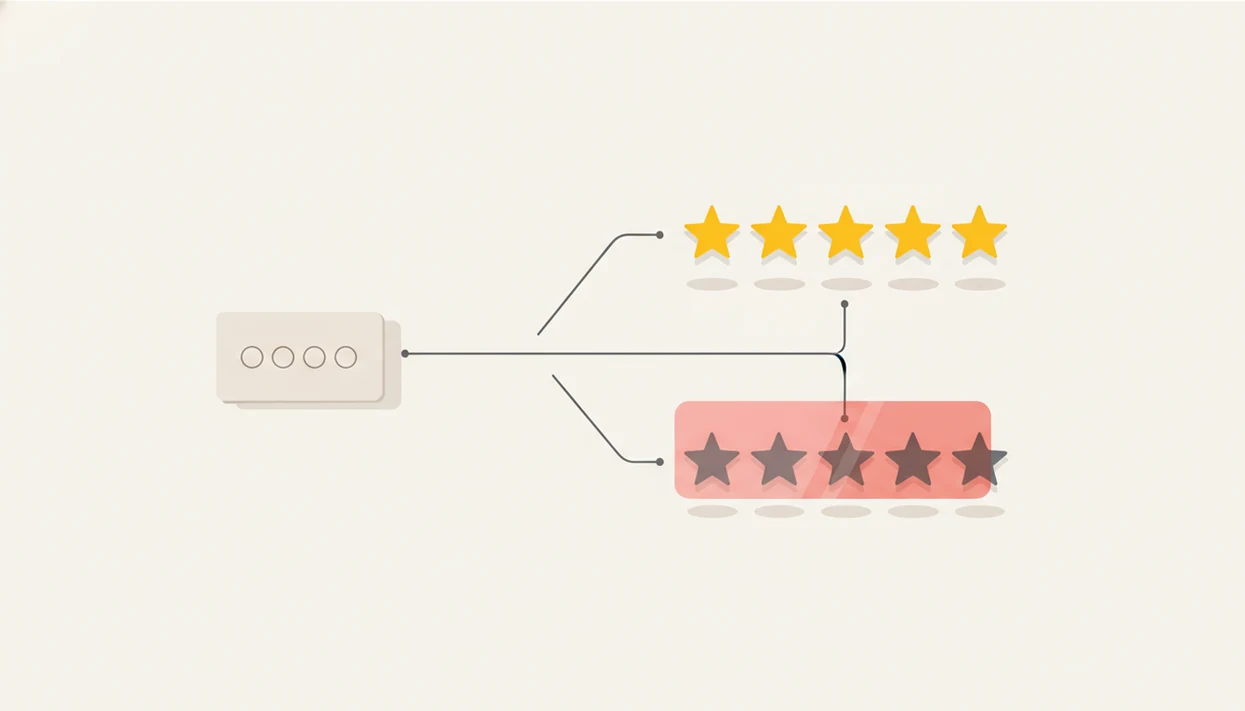
No, can I ask only happy customers for reviews is usually the wrong framing: sending public review links only to satisfied customers can create review gating risk, especially on Google. A safer approach is to ask every real customer for honest feedback, use surveys to identify problems, and avoid hiding public review options based on sentiment.
This page is policy and trust guidance for review-request workflows, not legal advice. If reviews are tied to regulated industries, incentives, contracts, or active disputes, ask counsel or the review platform before changing the workflow.
> Definition: Selective review requests are review solicitation workflows that invite only satisfied customers to leave public reviews while routing dissatisfied customers away from public review platforms.
TL;DR
- Asking only happy customers for public reviews can be treated as review gating, not just smart marketing.
- Google says businesses must not discourage or prohibit negative reviews, so filtering review links by NPS or satisfaction score is risky.
- Use post-purchase surveys and NPS to find unhappy customers faster, but invite all real customers to give honest feedback without sentiment-based blocking.
Selective review requests and review gating risk in plain English
Selective review requests, often called review gating, happen when a business asks only satisfied customers to leave public reviews and routes unhappy customers somewhere private instead. The risk is not the survey itself. The risk is using the answer to decide who gets the public review link.
A common version starts with “How was your visit?” or an NPS question. A 9 or 10 gets a Google review link. A 6 gets a private comment box. That may feel tidy when the owner checks yesterday’s survey comments before opening the register, but it still filters public review opportunities by sentiment.
The issue is suppressing likely negative public reviews, not collecting private feedback. Private feedback is useful. Blocking the public path is where the trust problem starts.
Can I ask only happy customers for reviews on Google?
Can I ask only happy customers for reviews on Google? No, not if unhappy customers are discouraged, filtered out, or blocked from the public review path.
Google Business Profile guidance says businesses must not discourage or prohibit negative reviews or selectively solicit positive reviews from customers source. That makes a score-based funnel risky when only promoters see the Google review link. Asking every real customer for an honest review is safer than asking only people who already gave you a high score.
For small businesses, the awkward case is familiar: a customer says “everything was fine” at the counter, then gives a 6 out of 10 later. You can follow up privately and try to fix the issue. But you should not use that score to decide they are not allowed to see the same review option as everyone else.
Five facts about selective review requests small businesses should know
- Filtering review invitations by satisfaction score can be review gating. If only high scorers receive the public review link, the workflow is sentiment-based.
- Platforms may remove reviews or penalize listings if biased solicitation is detected. Google’s review guidance warns against selectively soliciting positive reviews, and the FTC’s final rule targets deceptive review practices that distort consumer perception source.
- Negative reviews are not always fatal when businesses respond well. A calm owner reply can show future customers that problems get handled.
- Online reviews influence purchase decisions, so trust matters as much as star rating. Pew Research Center found that 82% of U.S. adults at least sometimes read online reviews before new purchases source.
- Survey tools are safe when used for service recovery rather than sentiment-based review blocking. A post-purchase survey should help you close the loop, not hide unhappy voices.
One-star public reviews sting. A private comment can still be recovered.
Review gating mechanics in survey-first review funnels
Review gating works through a simple automation rule: ask a survey or NPS question, apply a score threshold, send high scorers to a public review page, and send low scorers to private feedback. That is how a survey-first review funnel can become noncompliant even when the first question looks harmless.
How review gating works: the system creates biased solicitation by changing the customer’s next step based on sentiment. In plain language, happy customers get the megaphone and unhappy customers get the side room. Platforms care because public review profiles should reflect real customer experiences, not only the customers most likely to praise the business.
A safer configuration uses the score only for service recovery tags such as ‘manager callback needed’ or ‘refund review,’ not for deciding whether Google, Yelp, Facebook, or another public review option appears.
Small-business automation makes this easy to misconfigure. A receipt link printed below the total, an email after delivery, or a QR code at checkout can all be fine. The trouble starts when the dashboard rule says “9–10: review link” and “0–8: private form only.”
Safer customer feedback surveys instead of review gating
A safer customer feedback workflow sends post-purchase surveys to all eligible customers and uses responses to trigger support, not to block review access. If a review invitation is part of the workflow, do not hide the public review option from unhappy customers.
How to use customer feedback surveys without review gating:
- Send the survey to every eligible customer after a real purchase, visit, delivery, or appointment.
- Ask one clear satisfaction or NPS question while the experience is still fresh.
- Trigger follow-up for low scores with a callback, refund review, replacement, or manager note.
- Offer honest review options consistently instead of showing public links only to high scorers.
- Review weekly trends in a spreadsheet tab with NPS scores, customer quotes, and one assigned follow-up.
Tools like Customer Feedback Surveys help collect post-purchase surveys, NPS scores, and review follow-ups for small businesses. Good customer feedback survey apps for small businesses collect post-purchase surveys, NPS scores, and actionable customer insights, not a filtered review profile built to hide complaints.
Selective review requests versus honest review requests
Selective review requests create more trust risk than honest review requests because they change the public review path based on sentiment. Private feedback is acceptable when it supports service recovery and does not replace or block honest public review opportunities.
| Workflow | Who receives the public review link? | What happens to unhappy customers? | Trust risk |
|---|---|---|---|
| Selective review requests | Only high scorers, promoters, or “happy” customers | Routed to private feedback instead of the public review path | High, because the process suppresses likely negative reviews |
| Survey-first support workflow | All eligible customers, if review links are included | Low scores trigger support follow-up, but review access is not hidden | Lower, because feedback and review access are separated |
| All-customer review invitation | Every real customer in the chosen audience | They may leave a public review, private feedback, both, or neither | Lower, because the ask is consistent |
For many small businesses, Google review follow-ups work better when the review request says “honest review,” not “positive review.” That phrasing matters when a manager is scanning comments after closing and deciding who needs a call tomorrow.
Four myths about asking only happy customers for reviews
- Myth 1: “It’s just normal marketing.” Asking satisfied customers to speak up is normal, but filtering public review links away from unhappy customers is different. That is the review gating risk.
- Myth 2: “A survey-first funnel makes it allowed.” A survey does not make the workflow safer if the score decides who sees Google, Facebook, or another public review option.
- Myth 3: “Small businesses are too small for enforcement.” A single local listing can still lose reviews, visibility, or trust if the pattern looks manipulated.
- Myth 4: “Negative reviews should always be avoided.” Negative reviews can hurt, but a thoughtful response may reassure buyers more than a spotless profile that looks engineered.
A restaurant guest tapping a card after dessert may not complain in person. The survey is your chance to fix the table experience, not your filter for who gets heard.
When to Get Legal or Platform-Policy Help
Get professional help before a review workflow touches incentives, discounts, contracts, or score-based routing. Counsel and platform support cannot make a risky funnel safe by default, but they can help you spot problems before a listing, customer dispute, or regulator does.
Use this as risk reduction, not a compliance guarantee. If a competitor, customer, or agency alleges review manipulation, pause the automation and escalate quickly instead of debating it in the dashboard.
- Ask legal counsel to review any review request tied to coupons, loyalty points, refunds, contract terms, employee scripts, or industry-specific rules.
- Contact platform support before turning on automations that segment customers by NPS, star rating, satisfaction score, complaint status, or purchase type.
- Document the workflow rules, message templates, consent records, timing, suppression lists, and audience criteria so you can explain what customers did and did not receive.
- Escalate concerns when someone claims the business is filtering reviews, discouraging negative feedback, or offering something valuable for public praise.
- Recheck the setup after any software change, new location launch, or manager-edited template.
Limitations
Compliant review requests reduce risk, but they do not give a business control over customer behavior, platform enforcement, or rating swings. Treat this as policy and trust guidance, not legal advice.
- You cannot control which customers choose to leave reviews after an honest request.
- Platform enforcement can be inconsistent, delayed, or opaque.
- Misconfigured automation can still create review gating risk, especially with score thresholds.
- Low-volume businesses may be hit hard by a few negative reviews.
- ROI data for review ethics is limited compared with platform policy and trust-based guidance.
- Competitors may appear to get away with selective review requests for a time.
- Facebook, Google, Yelp, and industry platforms may apply different rules.
- A public reply can help, but it cannot erase every bad impression.
Survey research by the FTC found that many consumers change purchase decisions after encountering fake or deceptive reviews source. That is why how to handle negative feedback before review should focus on fixing the issue, not burying the customer.
FAQ
Is review gating illegal?
Legality depends on jurisdiction, facts, and enforcement context. Review gating can violate platform rules and may create regulatory and trust risk, so businesses should get legal advice for specific compliance questions.
Does Google allow review gating?
Google does not allow businesses to discourage or prohibit negative reviews. That makes sentiment-filtered review requests risky when unhappy customers are blocked from the Google review path.
Can I send surveys before asking for reviews?
Yes, you can send surveys before asking for reviews when they are used for feedback and service recovery. The risk starts when survey scores decide who is allowed to see a public review link.
Can I ask customers for positive reviews?
Businesses should ask for honest reviews, not specifically positive reviews. A safer request says something like “Tell us about your experience” rather than “Leave us a five-star review.”
Can unhappy customers leave public reviews?
Yes, unhappy real customers should not be blocked or discouraged from leaving public reviews. You can still follow up privately to resolve the issue.
What is a review gate?
A review gate is a workflow that screens customers by sentiment before showing public review options. For example, an NPS score of 9 gets a Google link while a score of 6 gets only a private form.
Are NPS-based review requests allowed?
NPS can support review workflows if public review invitations are not filtered by score. Customer Feedback Surveys can be used for NPS follow-up, but the review path should not be hidden from detractors.
Do negative reviews hurt local SEO?
Negative reviews can affect trust, clicks, and conversion, especially for local businesses. Honest review profiles and good owner responses may be safer than manipulated profiles that create review gating risk.